
Atom Age Lovecraft
A Review of Frank Belknap Long's "Journey Into Darkness"
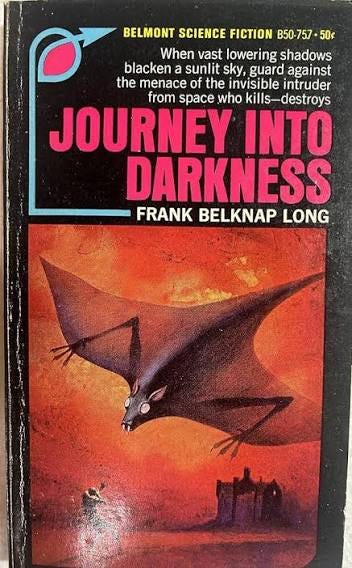
First and foremost, Happy Independence Day to all of our American readers. Hope you and your family are having a lovely holiday. Second, tonight’s CLASSICS FROM THE GRAVE is a 1967 love letter to Lovecraft written by a long-time friend.
H.P. Lovecraft (1890-1937) is widely recognized as one of the great masters of horror in the Western literary canon. Yes, that’s right. Despite the near-constant cries of “racism!” lobbied at the man, Lovecraft and his work are undeniably part of the Western canon, with Lovecraft being a rival of Poe in the greater garden of American weird fiction.
Hell, even just uttering the words “weird fiction” conjures up Lovecraft and practically no one else.
This was not always the case. A lot of writers often go overboard in trying to sell Lovecraft as some kind of unknown shut-in (his chronic unemployment meant that he had ample time to travel, including stops in New Orleans, Quebec, and Florida) who died penniless (true), friendless (not true), and unrecognized (a little bit of both). But, prior to his untimely demise from intestinal cancer, Lovecraft was a fairly well-known pulp writer whose work occasionally earned the distinction of being the cover story. He was among the most popular authors of Weird Tales during its golden years, and his bevy of friends and close correspondents came very close to getting Lovecraft a book deal in the early 1930s. Said standalone book would not appear until two years after H.P.’s death, and as has been recounted in these pages many times, August Derleth and Donald Wandrei were the men responsible for preserving their friend’s legacy.
Then, after World War II, something rather strange happened. All of a sudden, maybe thanks to the general interest in UFOs and anxieties over the dark side of science, Lovecraft became popular. His works began to be taught in college English courses, and from about 1960 until the mid-1990s, the Old Gentleman of Providence gained a kind of begrudging respect from the literary establishment [1].
At this time, the men and women who knew Lovecraft personally began publishing his letters, his critical rewrites of their stories, and all-new stories and novels that either featured Lovecraft as a protagonist or made generous use of his horrific cosmology. Strange Eons (1978) by Robert Bloch is perhaps one of the best-known Lovecraft pastiches of this time period, but there is another, slightly older novel that envisions a world in which Lovecraft’s interdimensional monsters are dreadfully real.
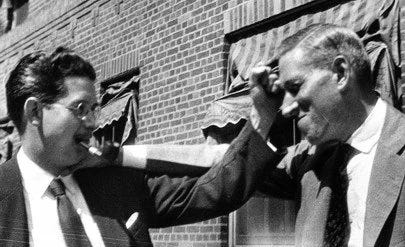
Journey Into Darkness was published as a paperback original by Belmont Books just as interest in Lovecraft was gaining steam. The novel’s author, Frank Belknap Long, was one of Lovecraft’s handful of IRL friends. Indeed, during Lovecraft’s years in New York, Long was a member of the KALEM Club—an informal reading and perambulating group that met weekly over coffee at a cheap New York City automat. One of the most popular pictures of Lovecraft features him playfully sparring with a young, mustachioed, bespectacled, and pipe-smoking Long.
Long’s Journey Into Darkness (1967) concerns one avant-garde psychologist’s attempts to reverse trauma by reaching deep into humanity’s primitive mind. These experiments unintentionally unleash entities from beyond who are so ancient that they are responsible for the primordial monsters of our collective nightmares (werewolves, vampires, zombies). Two patients—one a college professor suffering a nervous breakdown and the other a beautiful folk singer—decide to investigate the strange beings following a series of gruesome evisceration deaths that happen on the sand dunes right outside of the psychologist’s sanitarium.
Journey Into Darkness not only directly references Lovecraft and his fiction but also elaborates on his ideas by incorporating substantial elements of mystery fiction and Jungian psychology. The book is something of a mess—shoddy, ill-collected—but a beautiful mess nonetheless. And, much like the aforementioned Strange Eons, this quick potboiler is meant to appeal to science fiction fans who appreciate the outré and the cosmic more than space-opera pabulum.
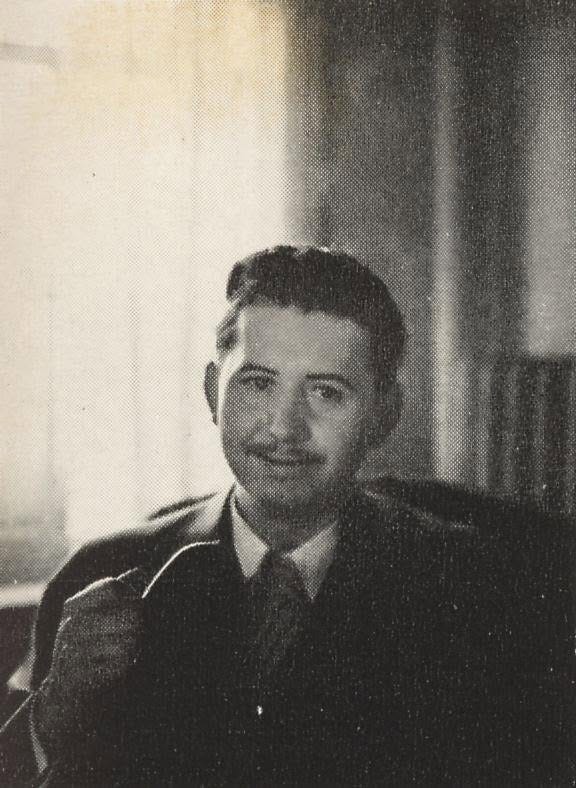
Frank Belknap Long (1901-1994) never outgrew the shadow of Lovecraft, despite outliving and outwriting the master by orders of magnitude. Long was a rare thing—an Anglo-Saxon Protestant born and bred in Manhattan. Born on April 27, 1901, Long was raised into a prosperous family on the Upper West Side (823 West End). Long’s father was a successful dentist, and with this practice, he put his son through the New York City public school system and indulged his son’s interests in natural history. Young Long was a voracious reader. Besides books on famous explorers and far-flung locales, Long enjoyed the fiction of Edgar Allan Poe, Ambrose Bierce, H.G. Wells, and Jules Verne. Eventually, Long found his creative outlet in amateur journalism, becoming an active member of the United Amateur Press Association (UAPA), which also included Lovecraft and Sonia Greene, Lovecraft’s future wife [2].
From 1920 to 1921, Long studied journalism at New York University before transferring to Columbia. He never graduated. Instead, following a months-long stay in New York’s Roosevelt Hospital following a ruptured appendix and peritonitis, Long decided to follow his dream of becoming a professional writer. For the remainder of his long life, Long worked as a freelance author and pulp writer, publishing in Weird Tales, Thrilling Wonder Stories, and various comic book titles, from Superman to Captain Marvel to Green Lantern. Long even bragged to August Derleth that he ghostwrote two or three Ellery Queen Junior novels.
Once the pulps dried up in the 1950s, Long turned to editing (he was an editor at The Saint Mystery Magazine, for instance) and novel writing. He wrote science fiction, crime, and gothic romance novels for several paperback publishers and under several pseudonyms. Long also penned poetry and even a story for the magazine of the television program The Man from U.N.C.L.E. However, despite his prolific and varied career, Long is best remembered today for a single story—the weird horror classic “The Hounds of Tindalos.” Originally published in the March 1929 edition of Weird Tales, “The Hounds of Tindalos,” which introduces the Space-Eaters in the Lovecraftian cosmos, became the headlining story for Long’s first short story collection, The Hounds of Tindalos (Arkham House, 1946).
Long died after a bout of pneumonia at the age of 92 on January 3, 1994. He was survived by his wife, Lydia, who followed her husband into the grave not long thereafter. Despite writing for seven decades, Long died so impoverished that the city originally buried him in a potter’s field. Fortunately, Long’s friends and admirers raised enough capital to have the great man’s bones reinterned at Woodlawn Cemetery.
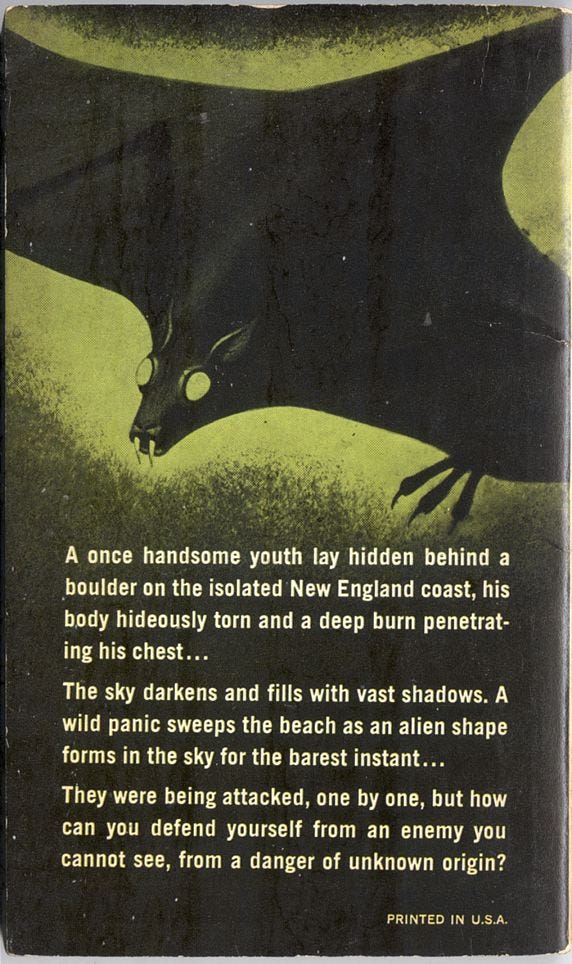
Journey Into Darkness takes place in the New England seaside village of Glenville. By all appearances, Glenville, which seems to be in Maine, is your typical sleepy village. However, unlike its neighboring communities, Glenville is home to a pioneering psychologist named Dr. Howland. Howland uses his sprawling mansion as a retreat and rest home for clients suffering from various mental maladies. During the July in question, Howland hosts a handful of sufferers: college professor Kilmer, folk singer and dancer Joan Wilderman, painter Barbara Freemont, another painter named Andrew Barkham, and a milquetoast young man named Robert Cleary. Although the novel is told in third-person omniscient, Kilmer is the main protagonist. He is a man in his mid-30s, well-read, and claims to be suffering from nervous exhaustion. Kilmer makes a quick friend in Joan, who is by far and away the most famous person in Glenville.
The frightening action all begins when the mutilated corpse of a young man named Cowles, another patient of Dr. Howland, is found half-buried in the sand dunes. An examination reveals not just exsanguination but also strange scorch marks on the dead man’s skin. This outrage intrigues Kilmer, who begins seeing strange visions in the skies above the ocean. Then, a few days later, another corpse is found butchered on the beach. This one bears the same telltale signs of mutilation and burning. Despite these crimes, Dr. Howland resists the idea of allowing Sheriff Henderson to complete a full investigation. The two men keep butting heads, even as a new corpse appears near the novel’s halfway point.
Something is clearly very wrong in Glenville, and the answer obviously lies with Howland’s facility. Kilmer and Joan agree to investigate the sand dunes, and when they do, a pervasive darkness falls over the summerland, and terrifying creatures appear in the mist. These creatures look like werewolves, gargoyles, and zombies. Afraid but undaunted, Kilmer articulates the idea that the creatures are beings from a different dimension somehow brought forth by Howland’s experiments. You see, deep within his home, Howland has rigged up a room full of Bauhaus furniture, where his patients are submitted to machines that read and record brainwaves while each subject watches a series of films. Kilmer thinks that these experiments have unleashed antediluvian Jungian archetypes that bequeathed to the earliest hominids their first fears.
To this end, Kilmer and Joan seek further information inside of Crawford’s folly, an abandoned castle in the hills that includes a fallout shelter built during the Korean War. Crawford’s folly proves to be another one of Howland’s laboratories, where non-Euclidean shapes have been crafted as defensive bulwarks against the unnamable horrors outside of time and space. Howland warns Kilmer and Joan to stay safe behind the shapes, but even he cannot save himself from being consumed and mangled by the entities. This is what happened to the others—their exposure to Howland’s experiments made them susceptible to the voracious creatures, who are depicted not unlike the space vampires in Long’s most enduring and anthologized tale.
Journey Into Darkness ends with Kilmer and Joan writing down their experiences and handing them over to the new sheriff (Henderson is killed by the monsters). Acting Sheriff Gordon has a hard time believing Kilmer when he says that the town’s horrors began as a result of Howland’s attempt to successfully swap minds.
Wait a minute, swap minds?
Yes! As revealed at the very end of the novel, Howland’s cutting-edge psychotherapy included the deliberate exchange of brains via on-surgical transference between the young and vigorous and the old and experienced. Fans of classic horror films may recognize this as the same plot as The Man Who Changed His Mind (1936), a Boris Karloff picture that features a mad scientist interested in…changing minds. Journey Into Darkness takes this premise and melds it with Lovecraft’s “From Beyond” to form a cosmic sci-fi horror yarn that runs under 160 pages.

Journey Into Night is generally sloppy in execution. After several strong chapters, in which the atmosphere feels more like a murder mystery than anything else, Long’s novel shifts into an academic discussion of Carl Jung, archetypes, and the origins of humanity’s monsters. Following that, the murder mystery angle is left behind as the narrative becomes more a sci-fi fantasy with a strong stench of deus ex machina (Crawford’s folly literally comes out of nowhere). Then, as if this were not bad enough, the entire narrative is summarized in three pages at the end.
Despite these handicaps, and despite the clear fact that Long wrote this paperback for economic reasons, Journey Into Darkness is a fun little ode to Lovecraft’s world of cosmic horror. Long does not upend or the rewrite mythos; he adds to it and stays faithful to the creator’s original intentions. Journey Into Darkness can stand on its own as a serviceable pulp story, but it may work better as a primer on Lovecraftian cosmicism.
3.5 out of 5.
[1] This would all evaporate when critical race theory gained steam in the humanities, and Lovecraft was singled out and, more or less, excised from academia for his views on race, democracy, etc.
[2] Long’s short story, “The Eye Above the Mantle,” published in the United Amateur in 1921, so impressed Lovecraft that he wrote a letter to Long. This is how their decade-long friendship began.