
Conjuring For the Elder Gods
A Review of "The Bizarchives #9"
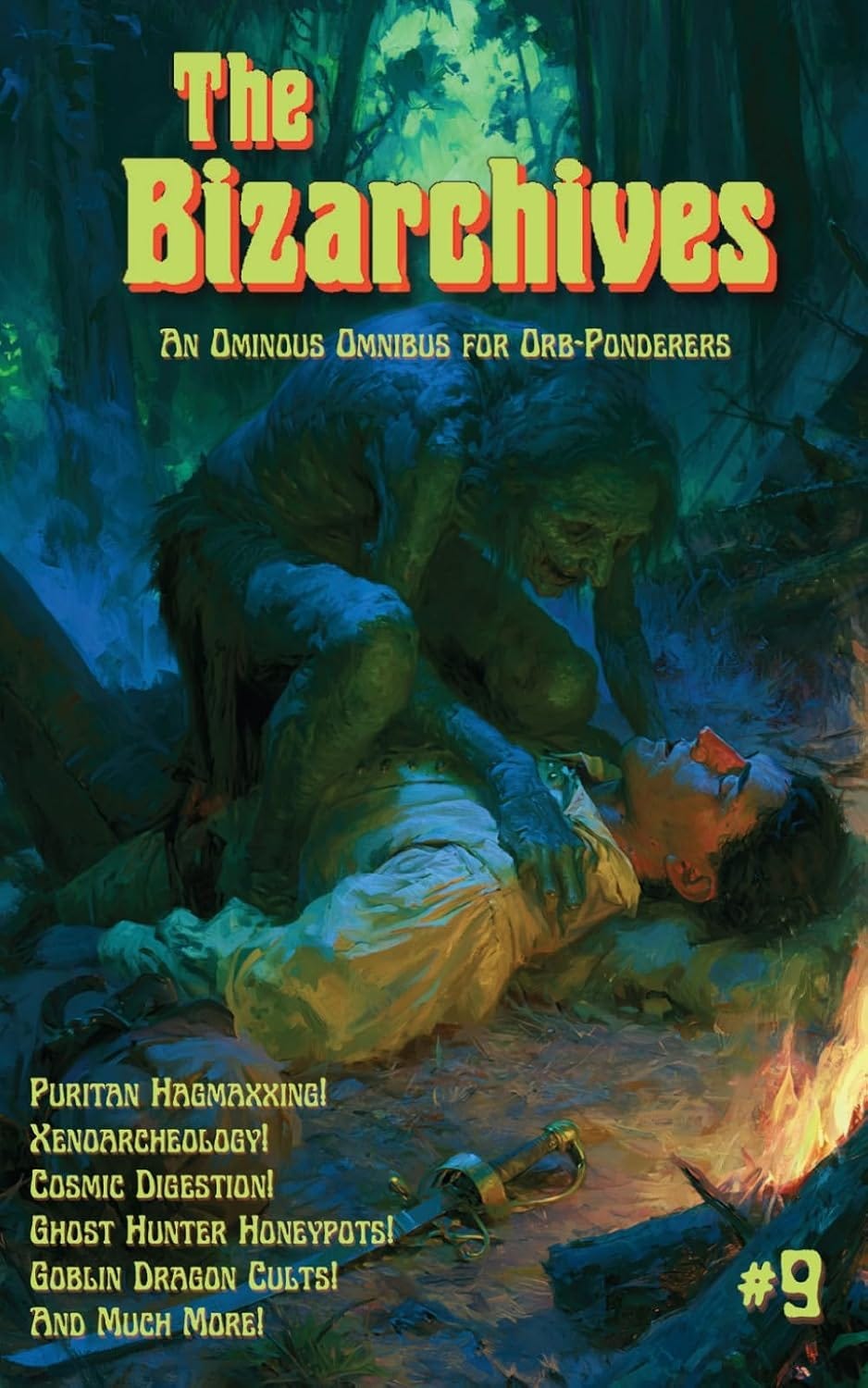
Welp, this is a first. You all know me by this point. I’m the unknown and unnamed author whom Big Dave employs to keep this Substack alive and kicking with book reviews. I think I do a pretty good job, but maybe you disagree.
(You better not disagree.)
So far, in the years since taking this position, I have reviewed novels, graphic novels, novellas, and short story collections. What I have never done is review a book that features me—little old me—as one of the contributors. Tonight, I will do just that by dipping my bloodied fingers and babbling brain into The Bizarchives #9.
It is hard to believe, but it has been almost a full year since The Bizarchives #8. That Halloween-themed volume brought the creeps and chills and was received rather warmly because of it. Now, with issue #9, the horror has returned and brought along other genres, from science fiction to dark fantasy and even mystery.
Let’s dive right in.
The first story is by a newcomer named Parker Longbaugh. A specialist in hard-boiled horror who penned last September’s amazing Darkness Over the Potomac, Mr. Longbaugh’s debut in The Bizarchives is a horror tale entitled “In Which Cotton Mather Comes to Believe.” Set in seventeenth-century Massachusetts, “In Which Cotton Mather Comes to Believe” has Cotton Mather—Puritan minister, demonologist, political theorist—as its main character. Here we see a young Mather traveling in wintertime New England with only a few apples, his horse, and a naval cutlass for protection. On the night of his journey, Mather falls asleep by his campfire and is promptly tortured by a hideous hag who attempts to bewitch him. A quick thrust of his tampered steel, plus the deployment of a crucifix (a rather naughty item for a Protestant) sends the hag into the darkness. Mather is not through with the fiend, however, and upon returning to Boston, young Cotton goes seeking after the hag. He knows that the monstrosity was born from a witch’s magick, and he further knows that witches can blend in with the populace. Mather finds his tormentor, but the conclusion is not easily foreseen.
Next, M.S. Jones, a veteran of almost every single issue of The Bizarchives, has not one, but two short stories in this volume. The first, entitled “Dark Harvest,” is set in the deep reaches of space. The starship Sudden Mercy, en route to a mining vessel named Raker, comes upon an obsidian obelisk—a kind of eldritch relic inexplicably located in an area used for interstellar mining operations. The crew of the Sudden Mercy makes a study of the inexplicable object, and, to their horror, finds that the item is alive. Alive and hungry!
Jones’s second tale, “Masks of the Mirror Maiden,” is a strange fantasy yarn about a place called the House of Faces where the dead can be seen again by those willing to suffer and pay. Abduran, our protagonist, is warned away from the House of Faces, yet he willingly pays for the tavern’s mistress, the enchanting Dahra, to haunt him with one particularly powerful mask.
If you like a little bit of verse thrown in with your prose, then you are in luck. The Bizarchives #9 features two poems: “Cantara” by The Epimenidean and “Hyperborea” by The Orb Ponderer. Both poems are in the same classic, epic, and weird vein as the poetry of Dave Martel and Robert E. Howard.
Besides Parker Longbaugh, there are two more first-timers in this volume. T.J. Martinell, a journalist in Washington State and a man with several novels under his belt, most recently one for our friends at 1325 Publishing, is the scribe responsible for “Death for Dinner,” an quasi-cozy murder mystery story set amidst the confines of an odd dinner-mystery gathering. Our detective seeks the truth about the murder of Edward Sullivan, a former actor with the dinner-mystery crew, and winds up becoming a part of the gruesome show. Cesare Weltschmerz, also an alumnus of 1325 Publishing, provides the short story “Holes Instead of Eyes,” about the death of an immortal and accursed creature that seems an awful lot like a werewolf.
I guess you cannot talk about rookie writers without at least mentioning me. My story, “The Translator,” was originally written way back in 2024. I don’t know the exact number of rejections, but there were a lot before I threw it into the “To-Read” pile for Dave and Arbogast. Thankfully, “The Translator” can now be enjoyed by everyone. This story is my attempt at a weird ghost tale, and it features a struggling graduate student who agrees to translate a demonic grimoire from the 17th century. As you might expect, things go sideways once our hapless translator starts fiddling around with the magic ceremonies contained within the grimoire.
And speaking of Arbogast, he is once again in The Bizarchives. The longest entry in Issue #9 by far, Arbogast’s “The Case of the Captive Corpses” is a new Midnight & Blackstone novelette. Here, Midnight and Blackstone begin what they think is a simple forgery case involving medieval Portuguese gold coins but soon find themselves the victims of a human smuggling operation run by ugly goblins for the purposes of feeding a primordial dragon. One of the best stories in the entire issue, “The Case of the Captive Corpses,” is a friendly reminder that the Midnight & Blackstone series is one of the absolute best things to come out of the neo-pulp revival.
Okay, that leaves us with just the OGs. Cole Grey’s ‘The Best Day of My Life” is a Bloch-esque revenge fantasy about a wheelchair-bound man’s quest to escape death. This quest sees him and his friends camping lakeside during a cruel summer in Kentucky—a cruel summer of death and sacrifice.
C.P. Webster, arguably the best writer to ever come from The Bizarchives, returns to his stock and trade by conjuring a ghost tale set in the lonely wilderness of Cheshire, England. The moors beckon to our haunted protagonist, who is trying to find sleep again after a terrible experience in Malaya during the war. By the story’s end, we know full well why this traumatized former soldier avoids sleep…
Finally, the very last story in the volume belongs to S.T. Hawkes. The author of The Molybdus Articulate, Hawkes’s story herein is as creepy and purple as you’d expect. “Godrinder” is set in a future where cybernetics and occult science have meshed together to create a society of “ectomancers” and psychonauts. “Godgrinder” presents less of a coherent story and more of a sensation of images, and all said images concern one unfortunate man’s descent into the jaws of a ravenous deity.
Despite being one of the shortest issues to date, The Bizarchives #9 is as good, if not better than, any of the previous entries. It is certainly one of the more varied volumes, as it presents many different flavors of pulp written by living masters. Speaking personally, my three favorite stories are “The Case of the Captive Corpses,” Webster’s “Revenants,” and Grey’s “The Best Day of My Life.” I also have a soft spot for “In Which Cotton Mather Comes to Believe.” And, if I can play Nostradamus for a second, I’ll wager that most readers will list either “Dark Harvest” or “Godgrinder” as their favorite.
What about you? Have you picked up the latest issue yet? If so, what was your favorite story? We at The Bizarchives need and want your support so we can keep churning out classics like Issue #9.
I like how this review highlights the variety of stories without giving too much away. Which story stayed with you the longest after you finished the collection?
Good review, looking forward to this issue. Bizarchives definitely has an impressive stable of authors.