
I am God's Executioner
A Review of A. Merritt's "Burn, Witch, Burn!"
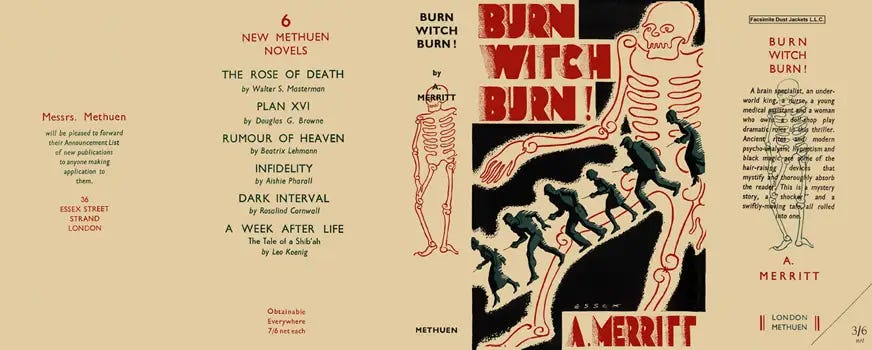
There are never “routine” nights for doctors. This is especially true if you’re a practicing medicine man in the Big Apple. In A. Merritt’s Burn, Witch, Burn!, the sawbones in question—Doctor Lowell—is called upon one evening by an infamous gangster. Said gangster (Ricori) brings with him a horrifying piece of cargo in the form of Peters, a recently deceased associate. Ricori offers the doc ten thousand dollars to discover the true cause of Peters’ strange death. Lowell refuses the money but takes the case. What follows afterwards is one of the strangest tales of the 1930s.
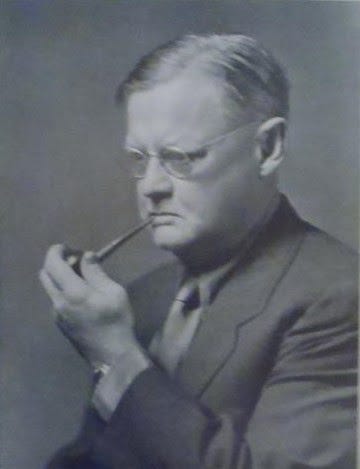
Little remembered today, Merritt (1884-1943) was one of the pioneers of science fiction and fantasy literature. Born in New Jersey and raised in Philadelphia, Merritt turned to fiction writing after a career in journalism (reporter for the Philadelphia Inquirer and editor of The American Weekly). His first novel, 1919’s The Moon Pool, established Merritt’s penchant for the fantastique. In that influential work, highly intelligent beings known as the Silent Ones live within the Earth’s core. The Silent Ones suffer under the curse of the Dweller—an evil, tentacled spawn of their own creation. The Dweller’s ritual of kidnapping humans and taking them down below draws the attention of a band of adventurers, who ultimately do battle against the secret civilization in their midst.
The Moon Pool was a tremendous influence on H.P. Lovecraft. Besides its usage of the “cyclopean” adjective, The Moon Pool and its subject matter (hidden cults living in twilight grottos, ancient, quasi-Atlantean civilizations that are superior to modern man, hideous and antediluvian monsters that appear fish-like) clearly inspired what would become the Cthulhu Mythos. Lovecraft would later write in his correspondence that he considered The Moon Pool one of the best weird tales ever written.
Merritt’s other important novels include the universally hailed fantasy The Ship of Ishtar (1924) and the horror-mystery Seven Footprints to Satan (1927), the latter of which became one of the last silent blockbusters. Merritt’s Burn, Witch, Burn! (1932) was similarly turned into a film—Tod Browning’s final fright film, 1936’s The Devil Doll. One fan of Merritt’s novel was the late Karl Edward Wagner, who saw fit to include Burn, Witch, Burn! as one of the Thirteen Best Supernatural Horror Novels ever penned. And this book is truly supernatural, and it’s a horror, and, as you will see, it’s pretty darn good.
Doctor Lowell’s examination of Peters fails to produce anything concrete beyond the theory that he may have died of some kind of heart ailment. After all, Peters died with a horrific look on his face and a satanic gleam in his eyes. This disturbing sight inspires Lowell and his assistant Dr. Braille to research other recent deaths in the city. The pair find seven similarly mysterious deaths between May and October. None of the victims, from the fifty-year-old spinster to the married professional acrobat, knew each other. Likewise, aside from sharing the same neighborhoods (which does not mean all that much in Manhattan), the only thing that the dead have in common is a fondness for children. When one of Dr. Lowell’s nurses is found murdered in the hospital, Lowell, Braille, Ricori, and the gunman McCann double their efforts to find a culprit. This is how they stumble across the doll shop run by Madame Mandilip.
Described as a hairy, hawk-nosed giantess with a mustache, Madame Mandilip is an expert dollmaker who runs her store alongside an exceedingly pale blonde named Laschna. Ricori is convinced that Mandilip is a witch. Lowell, an ardent defender of empiricism and science, refuses to believe this, even after discovering that Peters, Nurse Walters, and several others were murdered by animated dolls.
Yes, dolls. Living dolls that hack and slash at the throats of their victims. To top it all off, Lowell discovers that the dolls are miniatures of the recently murdered. Even the lamentable Peters is found harassing the ankles of a wino one night…
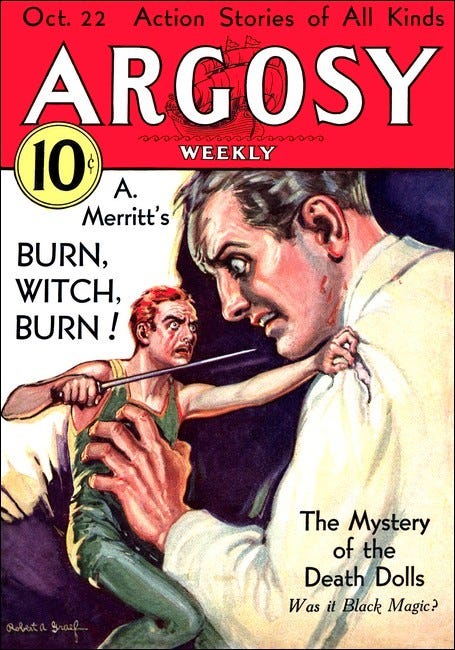
The whole case reaches its climax following the murder of Doctor Braille. Lowell visits Mandilip’s shop and is hypnotized. Convinced that the proprietor is the wielder of some unknown scientific trick, Lowell has Laschna kidnapped and questioned, whereupon she reveals that Mandilip is an immortal witch who has killed in every city that she has lived in. Furthermore, after killing her victims, Mandilip makes dolls out of them—soulless, bewitched dolls that carry out the witch’s instructions without complaint. Only one doll has ever refused Madame Mandilip: Nurse Walters. For this insubordination, Lowell discovers that the shrunken Walters is tortured and regularly crucified by her maker.
The final confrontation occurs in Mandilip’s shop. Here, the horrible hag temporarily masks herself as a beautiful woman, but this mask slips when the avenging spirit of the pure and virginal Walters drives a knife into the witch’s throat. The superstitious Ricori thereafter sets fire to the corpse, echoing the title’s refrain of “burn, witch, burn!”
Merritt’s little horror novel is a gem. Bereft of unnecessary scenes and characterization, this pulpy horror tale gets to the point quickly. That is not to say that it is overly formulaic, although it definitely overplays the whole science vs. magic debate. Of note is the fact that the gangster Ricori is depicted as well-read and something of an expert on the occult. Ricori is also a devout Christian who calls himself “God’s executioner” when Lowell questions the legality of their mission. McCann, Ricori’s chief gunman, is a loyal Paladin who performs the role of the square-jawed hero throughout the book. Neither of these ostensible criminals make a mistake in the novel, while the nominal hero Lowell makes several and can be accused of being too stubborn for his own good. Burn, Witch, Burn! plays with these expectations and more, and speaking as a resident of the twenty-first century, I enjoy the fact that Merritt made his witch a visibly disgusting creature instead of an enchanting and comely wench. Also, the invocation of black magic and dollmaking should remind readers of the 2024 horror film Longlegs, which pursues a similar premise, albeit with more arthouse pretensions and less pulp flair.
Overall, old KEW was right on the money with this one. Burn, Witch, Burn! is sensational, if not a little too short. Merritt was a solid writer and a creative genius, and frankly we should reassess his work as worthy of inclusion among the greats of weird fiction. Burn, Witch, Burn! is not weird horror, but it is good horror, and good horror always deserves to be read.
4.8 out of 5.
I love 'Burn, Witch, Burn!'...there are some great dramatic readings of this on Youtube.