
The Schuylkill Horror
A Cosmic Appalachia Terror Tale by D. Martel

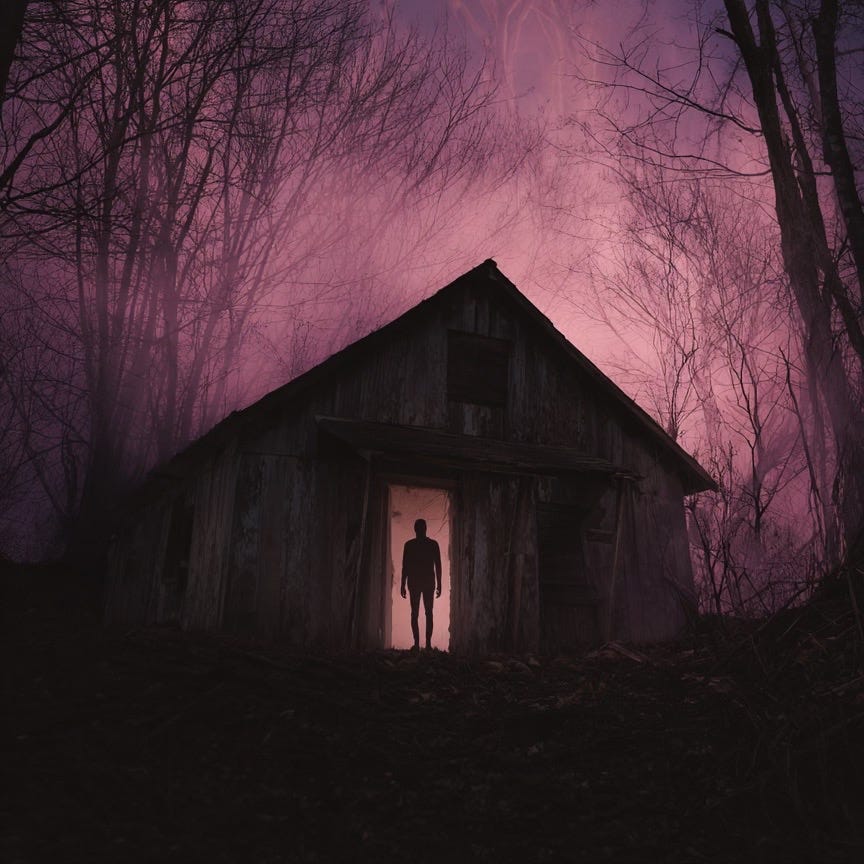
My Chevrolet Blazer hummed as its steel carapace charged up the winding Appalachian roads. Dead trees swayed in the winter gusts allowing glimpses of the barren Pennsylvania valleys below. I couldn’t look more than a moment for fear an incoming driver would collide into me head on. My home town in southern New Jersey was a place interconnected by long reaches of multi-lane highways. I wasn’t accustomed to pothole-addled roads a car and a half wide. Even more treacherous were the barriers of wooden stumps with rope strewn between.
Perhaps it was all the municipality could afford. Given that their roadways seemed to have been built for horse-drawn wagons and never expanded for motor vehicles. I couldn’t imagine such a place drew much tax revenue for such things. But it was still disconcerting that at any moment my truck could go careening off the side of a mountain and the only thing to save me was an old rope and a few stumps. Clearly the fate of some poor folks. Every so many miles was a missing section of the barrier and a wooden cross placed nearby.
Among the grey haze clung an ethereal sadness about this place. Despite being less than a decade from the turn of the century, this place seemed to be entombed between eras. I had driven only several hours from the bustling economic hubs of south Jersey yet it felt like I had traveled backwards through time. The locals were sullen-eyed and had a quality about their faces that told all whom beckoned their gaze of their remembered generations of hardship.
Schuylkill county was like the rest of the unremarkable countryside of Pennsylvania. An unfriendly landscape that has shaped men into a fashion reminiscent of ages left behind. In these mountains you can find the sons of the old world. Still carving out a meager existence in abandoned coal towns and misty mountain valleys. Wild and beautiful, still wholly uncultivated yet grim and mysterious with its impassable cliffs.
I spun my wheel and my suspension croaked as the truck crawled onto a steep shale driveway. It struggled and rocked as its tires dipped into small craters and over fallen branches. I parked in front of a partially collapsed wooden lean-to that was at some point used to shelter firewood. But left barren with nothing more than the black traces of organic rot. Cropping out of the rock face beside it was the rusted corpse of an old coal chute installation. The catwalks long decayed leaving a corroded iron frame slowly twisting under the crushing weight of Father Time’s merciless boot.
I swung my door open and climbed out into the frigid evening air. The wind blew with a thick moisture that stung my bare face. With brisk steps crunching on the loose stone I approached my destination. A large one-story cabin of previous century’s construction. Warped wooden panel siding horizontally stacked from a poured foundation. Several falling off the rotting frame revealing exposed insulation and frayed wiring. Dingy single-pane windows obscured by either frost or filth.
It was 1985 when I first crossed paths with the enigmatic Z.J. Muller. After failing out of university I found myself working long overnight shifts at a particular manufacturing facility of no consequence. Needless to say, I spent many grueling shifts sitting on a stool overseeing the operation of a machine. Every so often my duty was to troubleshoot the machine and restart its cycle. This resulted in indiscernible passing time in the bleak witching hours listening to the maddening repetition of gears as fluorescent bulbs hummed overhead. At first I filled this monotony of idleness with reading as we weren’t allowed to bring a Walkman.
I found solace in the pages of the great supernatural writers of old. The fantastical, sublime and strange. Science fiction, fantasy and beyond. But as the weeks passed my focus waned. I began conjuring my own tales in my head as I sat through the bore of my shifts. After I rushed home I would begin writing. The English lessons from my brief stint in college were still fresh in my mind so I could self-edit and polish. But to my dismay, all of my submissions to various magazines were rejected.
In one particular case, the editor told me that my own name, Antonio Grimaldi, was a mouthful and I should adopt a pseudonym. So I conjured the idea of starting my own magazine. I bought an old Xerox copy machine and purchased several reams of paper. So I became “Tony Grim” and called my publication “GrimWorld magazine”. It was a play on the word “grimoire” blended with my name and the word “world”. I was quite proud of this clever little brand.
High and low I advertised for authors in coffee shops and book stores. Faxed flyers to schools and libraries. In a few weeks time I received a fair few manuscripts. To which I would read through during my work shifts. Until I stumbled upon a tale that read at the top:
Schizomorphics
By Z.J. Muller
It was a hideous yarn about psychic parasites that infected the minds of humans. As a result the hosts’ psyches would deteriorate into a schizophrenic state. While in this state they would slowly lose the ability to discern between their reality and the parallel dimension from which the parasites came. Thus leaving the reader unsure of which reality was the true one. A vivid and psychedelic tale that many interpreted as a sobering commentary on the dark power of human perception and group hysteria. I adored the story and knew the sensitive few with macabre dreams like myself would find it intoxicating. With a few long nights of strained eyes and fingers stained with toner, I finished my prototype. With mere hours before my shift, I held my creation into the light and leafed through its stapled pages. It was a bit of a mess. Text alignment was far from perfect and several of my sketched illustrations came out overexposed. Despite these imperfections, I was elated. I cackled like a mad sorcerer at my creation.
It was then that I realized I was late for my shift again. Upon arrival at my usual work station, my manager was waiting for me. He was a portly middle-aged man with a permanent five-o-clock shadow and recessed chin. The quintessential avatar for the upjumped corporate toadie archetype. A sniveling little man that scurried among the industrial corridors performing supplicant tedium at the behest of his faceless superiors. I stared into his caffeine-addled bloodshot eyes as he stoically recited the termination procedure. However, his words were but muffled noises as my mind raced with anxious thoughts about my magazine. Before he could finish his patter I leaped up from my seat and blurted out jumbled canards about being thankful for the opportunity. I don’t even remember rushing out or the following days of broken sleep and obsessive toil. Those days were a blur overlaid by the sound of my struggling Xerox and bubbling moka pot.
I smile when I consider the absolute disregard I had for my own financial future as the magazine venture just possessed me. It was out of my character as a lifelong underachiever with a slight aversion to risk-taking. I drained every dime I had without any consideration of failure. And it did fail at first. For the entire first year I took out lines of credit so I could rob Peter and pay Paul. Months passed by as I sold more. More submissions from quality authors poured into my mailbox. And while many writers made their way through GrimWorld magazine, the readers couldn’t get enough of Z.J. Muller and his bizarre tales. Eventually GrimWorld was bought out by a large publishing outfit who placed me in the chief editor position along with a healthy salary. In the subsequent years I starred on panels at conventions and wrote out sizable royalty checks to our writers. Many went on to become successful themselves signing deals for bestselling novels. All of whom I had met and kept frequent contact with. All of whom except Z.J. Muller. Despite the advent of digitization, Muller was the only one who would continue to submit via postal service. Occasionally including a handwritten letter with correspondence regarding developments in his personal life and long analyses of films and albums that he never wanted published. He never appeared at any event despite countless invitations and never returned any phone calls. Zachery J. Muller was only slightly less mysterious to me as he was to the rest of the world. The only details I truly knew about his personal life was where he lived, because that’s where I would mail his checks. And that he had a fiancée whom he planned to marry but had left him. It was at this time that his submissions grew increasingly bizarre and not in his trademark fashion. The writing was disjointed and scrambled, incoherent and repetitive at times. In between described grotesque scenes in vivid detail. None of which I would want to repeat and especially nothing I could publish.
I was concerned that perhaps he was struggling with his mental health. A malady not uncommon in this field. Some of the greatest storytellers, especially of the dark variety, were afflicted with such ailments of the mind. Not just Poe and Howard but even in my personal experience, the gift of grim imagination can commiserate with chronic melancholy and worse. And my suspicions were supported by the abject disrepair of his dwellings. I came out of concern, yes. Although selfish, I was mostly motivated by my own curiosity. I breathed the frigid air deeply and expelled a white cloud condensed with nervousness. It was almost like finally meeting a long-lost family member to whom you are unsure how they’ll react. After a brief pause I rapped my numbed knuckles upon the cracking wood of his old oak door. The aging porch planks bowed and creaked beneath my soles. I knocked again but a bit louder after a few moments but to no answer. There was no sound of movement from within. I didn’t see another vehicle in the driveway and no light emitted from the interior of the house. I leaned a bit over the railing to peer inside one of the windows. I could make out the vague forms of kitchen furniture through the hazy glass and dark curtains. It was possible that this was an old address and he no longer lived here. By the appearance of the house, I don’t think anyone would want to live here.
As I lifted my hand a third time for a final knock I could hear the mechanical clicking of the door lock from the opposite side. I placed my hands to my hips and looked on in anticipation as the door slowly swung awide. A gaunt form stood motionless in the darkness beyond the door frame. A pair of large glassy eyes stared out from the shadows and through me to a distance behind. A lanky frame about half a head taller than I stood draped in baggy, ill-fitting clothes. A faded brown polo shirt and tattered sweat pants which lazily folded over worn moccasins. He nervously clasped his fingers entwined and rubbed one thumb over the other knuckle. His hazel round eyes sunk deeply into his moon-shaped face as he anxiously moved his shaggy unkempt hair from his vision. His features were long and pronounced with a near swarthy quality. It looked as though he was naturally a dark German with a bit of reddishness but has since flushed out without proper sun, leaving a sickly green hue to his complexion.
“Mr. Muller? I’m sorry for showing up out of the blue. It’s me, Tony.” I offered my hand as I cleared the cold from my throat. He continued to stare through me with blank expression. I quickly turned my head to give a quick glance behind. My eyes came back to meet a forced half smile and stare that now met into mine. After a few more strange moments he placed his palm into mine. His hand offered no warmth in my icy grasp as he squeezed.
“Come in,” his voice rattled with phlegm.
I followed him through the doorway and as the freeze melted from my nostrils, I was immersed in the stagnant stench of the house. Dust, filth and the putridity of a hoarder’s neglected kitchen hung about the stale air. Cascading trash from a buried can piled across the kitchenette floor and into the dining area. To which a small round table piled with books and unopened mail sat, slightly tilted in disrepair. A pair of antique cushion chairs sat with coats and soiled clothes draped over them. He shuffled to the table and shoved a bit of the clutter to clear a place for me to sit. I indulged his offer as he sat across from me with blinkless gaze.
“It’s a pleasure to finally meet you after all these years, Z. It feels a bit strange considering how far we’ve both come in our endeavor. Not strange in a bad way. But, y’know.” I said.
“Yes. Strange,” he uttered with his eyes trailing off.
“I hope I didn’t come at a bad time,” I said.
“Bad time?... Sometimes bad times are the best times. It’s strange...” he said as drool leaked from the corner of his lips.
“Yeah... I guess it’s how you look at it, right?” I shrugged. He stared through me as his head slowly nodded in agreement. A brief moment of awkward silence fell in the room as his attention disassociated.
“The reason I came is because I was traveling through the area and I wanted to swing by. I mean, obviously, I wanted to finally meet you. But I also have a few offers from Terry Leer. He said he tried to reach you but you never returned any of his calls,” I said.
“Who’s that?” Z.J. asked.
“Terry Leer. He’s our agent at Oldstone Press. He’s dying to get a novel from you,” I said.
“Not interested.” He curled his lip.
“I just figured I’d pass it on. He’s offering...”
“NOT interested.” He barked.
“Hey, no problem. Here’s a few contracts and proposals...” He snatched the envelope from my hands and hurled it into the kitchen trash pile. I attempted to hide my smile as the papers fluttered wildly through the air. It was an absurd reaction that caught me by surprise. He cut a half smirk as he shared in my amusement at his outburst.
“Alright? Fuck me then,” I smiled.
My eyes wandered the room as the tension dissipated. Above the deteriorating couch hung a portrait in an ornate frame. The painting depicted a woman in old-fashioned dress, perhaps from the late 1800s. Her face was stern yet beautiful in that austere Victorian manner. Something about the brushstrokes seemed almost luminescent despite the grime coating the glass.
“That painting,” I gestured. “Is that your grandmother or something?”
Z.J.’s entire demeanor shifted. His glassy eyes suddenly focused with an intensity that made my skin crawl. A smile stretched across his face, too wide, showing too many teeth. He stood abruptly, his chair scraping against the floor.
“That’s Elizabeth,” he said, his voice pitching higher with barely contained excitement. “The woman who built this house. My muse. My love.” He approached the painting with reverence, reaching up to touch the frame with trembling fingers. “She sings to me. Every night Elizabeth sings and her love... her love inspires everything I write. Isn’t she an exquisite beauty?”
The way he said it made my stomach turn. There was something deeply wrong in his voice, in the way his body language had transformed from withdrawn to almost manic. I cleared my throat.
“Yeah, uh... sure. Listen, the weather’s really turning, huh?” I nodded toward the window where fat snowflakes had begun to fall. What had been a light dusting was rapidly becoming a proper snowfall.
Z.J. turned from the painting reluctantly, as if breaking away from a lover’s embrace. He shuffled to the window and stared out at the accumulating white. “Yes. It’s coming down hard now.”
Within the hour, the storm had become a full blizzard. Wind howled around the cabin’s corners and snow fell so thick I couldn’t see my truck through the window. Z.J. insisted I stay the night, and with visibility at zero, I had no choice. He showed me to a spare room down a narrow hallway. The room was sparse and freezing. I piled every blanket I could find onto the sagging bed, but the cold seemed to seep up through the floorboards.
As night deepened, the temperature dropped further. I lay shivering beneath my mound of covers, unable to get warm. Then I smelled it. A sweet putrescence, like flowers rotting in honey. It wafted up from somewhere below, carried through ancient heating vents. Along with it came sounds. Soft at first, then more distinct. A wet scraping, a gurgling that might have been pipes but had an almost organic quality to it. The sounds seemed to move through the walls, beneath the floor, echoing through the ventilation system.
I felt strange. Light-headed. The smell was cloying, making my sinuses burn and my thoughts swim. Eventually, exhaustion overtook my unease and I drifted into fitful sleep.
The nightmares were hideous. Disjointed images of writhing shapes and geometries that hurt to perceive. The gurgling sounds from my waking hours bled into my dreams, but there they sounded almost like singing. Beautiful and terrible. In the distance of these fever-dreams, I saw her. Elizabeth. The woman from the painting. A silhouette standing in impossible darkness, beckoning.
Morning light filtered weakly through the frost-covered window. I stumbled out of bed, groggy and disoriented. Z.J. was nowhere to be found. The house felt even colder than the night before. I pulled on my coat and ventured outside into knee-deep snow. The blizzard had subsided to light flurries, but the wind still cut like razors.
My truck was buried. I brushed off the driver’s side door and climbed in, turning the key. Nothing. Not even a click. The engine was completely dead. I popped the hood and stared at the frost-covered engine block. I knew nothing about cars. The battery terminals, the belts, the various fluids—it was all just shapes and metal to me.
Defeated and freezing, I trudged back inside. I remembered the hoagies I’d packed in a cooler in the truck bed. I retrieved them and carried the small cooler back into the house, stomping snow from my boots.
Z.J. was sitting at the table. Waiting. As if he’d materialized from nowhere.
“Where did you come from?” I asked, startled.
He ignored the question entirely. His eyes fixed on me with that unsettling glassy stare. “A tow truck isn’t going to make it up the mountain,” he said matter-of-factly. “Not in this.”
I hadn’t mentioned the truck. Maybe he’d seen me outside working on it. That had to be it.
“Listen, Z., I’m worried about you. This place... I think you should get it tested. There might be gas leaking up from the old mines underneath. It could be making you sick. Hell, it could be making ME sick. I smelled something awful last night.”
Z.J. stared at me for a long moment. Then, as if I’d said nothing of consequence, he gestured to the wall. “You can use the phone to call for a tow truck if you’d like. Phone book’s in the cabinet.”
I found the phone book wedged between expired boxes of cereal and crackers. Behind them, I glimpsed other things. Wallets. Several of them. A woman’s ring. A man’s watch. Other personal effects that had no business being in a kitchen cabinet. My chest tightened but I forced myself to focus on the phone book.
I dialed the number for a local towing service. The phone crackled to life, but instead of a dial tone I heard only static. No, not static. It was that sound. That wet gurgling I’d heard in the night, now amplified and distorted through the phone line into a cacophonous shrieking.
“Goddammit!” I slammed the receiver down. “Phone’s not working.”
“Everything up here goes down when storms come through,” Z.J. said calmly. “It’ll be back on soon.”
“How soon? I need to get back.”
“Soon,” he repeated. Then he reached for the cooler and pulled out one of the hoagies. He unwrapped it slowly and brought it to his mouth.
What I witnessed next made my gorge rise. He didn’t bite. Didn’t chew. He simply opened his mouth and pushed the sandwich in, mushmushing the bread and meat around with his tongue like an infant with food. Drool and bits of shredded lettuce leaked down his chin as he worked the mass around his mouth, swallowing in wet convulsive gulps without his teeth ever meeting. The sound was obscene. Moist smacking and gurgling as he swallowed again and again, his throat bulging with each gulp.
I looked away, my own appetite completely destroyed.
He turned to me, mayo and tomato juice glistening on his chin. “Are you going to eat?”
“You can have mine too,” I said quickly. “I’m not hungry.”
That night was worse. So much worse. The smell returned with greater intensity, filling my small room until I could taste it coating my tongue. Sweet and rotten, like meat soaked in perfume. The fever-dreams came faster. The gurgling beneath the floors grew louder, rhythmic. And the singing. God, the singing. Beautiful and alien and wrong. It didn’t sound like music should sound. It had too many tones, harmonies that shouldn’t exist, rhythms that made my heartbeat stutter as it tried to synchronize.
I woke to the sound of something scraping beneath my floorboards. Long dragging sounds, like nails on wood or stone. The gurgling was all around me now, seeming to emanate from the walls themselves. I couldn’t tell anymore where the sounds ended and my nightmares began. Were my eyes open or closed? Was I awake?
Footsteps in the hallway. Slow and deliberate. I heard them pass my door.
I threw off the blankets and rushed to the door, yanking it open. The hallway was empty. Dark and empty. But I could still hear the footsteps, now coming from another part of the house. And beneath everything, that constant gurgling singing that made my head swim.
I went to the small radio on the bedside table and turned it on low. After several seconds of static, a crackly country station came through. The music was poorly received, cutting in and out, but it was real. Normal. Human. It anchored me. The strange sounds began to fade, pushed back by the radio’s drone.
Then the music cut for a station break. A local news announcer’s voice, tinny and distant through the static: “...authorities are still searching for several individuals reported missing in Schuylkill County over the past year. Anyone with information...”
The wallets. The jewelry.
My blood went cold. I leaped from the bed and ran down the hallway to the phone. I grabbed the receiver and punched in 911. That sound again. The gurgling singing poured through the earpiece, louder than before, cascading over itself in impossible harmonies.
I looked down the hallway toward Z.J.’s bedroom. A silhouette stood in the darkness. Tall. Motionless. Watching.
Terror seized me. I dropped the phone and bolted for the front door, throwing it open and plunging into the deep snow. The cold hit me like a physical blow but I didn’t care. I had to get out. I had to run.
I dug my way to the truck, yanked the door open. Turned the key again and again. Nothing. The engine was frozen solid. Useless.
I started running down the driveway, or trying to. The snow was up to my thighs in places. The wind howled, driving sharp crystals of ice into my face. I couldn’t see anything in the pitch blackness. No moon, no stars. Just screaming wind and endless darkness.
I stumbled forward, fell, got up, fell again. My legs were going numb. I couldn’t feel my hands anymore. The cold was inside me, slowing everything down. My thoughts grew sluggish. My movements became clumsy.
I collapsed into the snow and couldn’t get up.
That’s when I heard it. The singing. Clearer now, more beautiful than anything I’d ever heard. It was calling me. Welcoming me. I saw her silhouette approaching through the storm. Elizabeth. She knelt beside me and placed a hand on my head. It felt warm. Comforting. I let the feeling wash over me.
When I woke, I was back in my bed, wrapped in what felt like every blanket in the house. My teeth chattered violently. I couldn’t stop shaking.
Z.J. stood over me. He held a cup of tea to my lips and I drank. The warmth was exquisite. He set a plate of crackers on the bedside table.
“Easy now,” he said softly. “You have a terrible fever.”
I tried to speak but my throat was raw. Finally I croaked out: “The wallets... in the cabinet. And the radio... the missing people...”
Z.J. tilted his head. “That radio doesn’t work. Hasn’t for years. It’s not possible you heard anything on it.” His voice was gentle, patient. “And the wallets are just things I’ve found while hiking on the Appalachian Trail. The trail runs right by my property. People drop things all the time.”
“How did I get here?” I whispered.
“I heard you get up in a panic and rush out. I followed your trail in the snow and carried you back. You’re lucky you didn’t freeze to death. People die like that all the time up here.”
My mind was fuzzy. Had I imagined the radio report? The fever made everything uncertain.
“This place is haunted,” I said, my voice cracking. “There’s footsteps at night. Strange sounds under the house.”
“I’m a night owl,” Z.J. said. “Always have been. That’s why I’m not around in the morning. I sleep in. Insomnia.” He pulled the blankets up higher around me. “And the sounds... this house is old. The wind, the pipes, they make all kinds of noises.”
Something about his normalcy felt performative. Too practiced. But I was so tired, so confused. Maybe he was right. Maybe the fever was making me paranoid.
“You need to rest,” he said. “When the storm is over I’ll shovel the driveway and get you to a doctor.”
I drifted in and out of consciousness. The dreams continued, each more bizarre than the last. The singing wove through everything. Days and nights blurred together. I couldn’t tell how much time was passing. The fever had me in its grip, holding me suspended between waking and sleeping.
Finally, one morning, I woke feeling weak but clear-headed. The fever had broken. I was drenched in sweat, my clothes sticking to my emaciated frame. I’d lost weight. How long had I been sick?
I struggled to the bathroom. The mirror was dingy, covered in grime, but I could see my reflection well enough. My skin had taken on that same sickly green-grey pallor as Z.J.’s. My eyes looked sunken, my cheeks hollow.
Z.J. was nowhere to be found again. I shuffled to the window and pulled back the curtain. Green grass. The snow was gone. Early morning sun cast long shadows across the lawn. How long had I been here? A week? Two?
Something in me snapped. I needed answers. I went to Z.J.’s bedroom door and found it locked. I threw my shoulder against it. The old wood splintered easily.
The room was piled high with books and papers, towers of junk creating narrow pathways. But near the bed stood a writing desk covered in scattered pages and notes. And directly beside it, an altar.
My breath caught. The altar was crude but deliberate. At its center sat an effigy unlike anything I’d seen before. It was vaguely organic in shape, with too many angles and protrusions that seemed to shift when I looked at them directly. Beside it was a hand-sketched drawing of Elizabeth, the woman from the painting, but in this rendering she had tendrils extending from her body, writhing outward like the arms of some deep-sea creature.
In front of the effigies sat an ornate knife, ritual tools whose purpose I couldn’t fathom, and a small bowl filled with dark, congealed blood.
I stepped closer, my heart hammering. That’s when I noticed the scrape marks on the floor. Long gouges in the wood leading underneath the altar.
I grabbed the altar and yanked it aside. Beneath it, set into the floor, was an old wooden door with an iron ring handle. I pulled it open to reveal stone steps descending into darkness.
The smell hit me immediately. That sweet putrescence, now so strong it made my eyes water. I should have run. Should have fled the house and never looked back. But I had to know.
I descended.
The stone walls wept with moisture. But it wasn’t water. The dampness had a brownish-pink tint to it, organic and viscous. It coated the walls in a film that caught the dim light from above. The smell grew thicker with each step, cloying and horrible.
At the bottom, a faint light glowed. I entered a chamber and heard a wet crunching beneath my feet. I looked down.
Bones. The entire floor was carpeted with bones of all sizes. Human bones. Femurs and ribs and skulls, all coated in that pink-brown moisture that made them glisten in the dim light. Some were old and yellowed, others still had traces of tissue clinging to them.
In the corner of the chamber stood a large well with a knee-high stone wall around it. Beside it was a heavy work table. Z.J. stood at the table with his back to me. He wore a leather apron splattered with dark stains. When he heard me, he turned around.
He was smiling. In his hand was a butcher’s saw, still dripping.
“Tony,” he said warmly, as if greeting an old friend. Then he turned back to his work.
I approached on legs that felt like they weren’t my own. My mind was screaming at me to run, but I couldn’t move. I had to see.
On the table was a corpse. Or what remained of one. It had been systematically dismembered, limbs arranged neatly beside the torso. The work was methodical. Practiced.
“What are you doing?” I heard myself ask.
Z.J. didn’t answer. He positioned the saw against one of the remaining limbs and began cutting. The sound was worse than anything I’d imagined. Wet grinding, the scrape of steel on bone. When he finished, he held up the severed arm, blood and other fluids dripping from the stump.
That’s when it rose from the well.
At first I thought I was hallucinating. My fever-addled brain conjuring nightmares into reality. But the thing was solid. Real. It emerged from the darkness of the well like a flower blooming in reverse, a grotesque mockery of life.
It was a mound of undulating flesh, brownish-pink like the substance coating the walls. Its surface writhed with countless tendrils of varying thickness, each one moving with hideous independent purpose. At its apex was something that might have been a mouth—a circular opening ringed with thick, lip-like folds of flesh. Within that orifice, deeper in the darkness, I glimpsed something like a beak, chitinous and sharp.
The tendrils reached upward, grasping, and the sound it made—that wet gurgling I’d been hearing for days—intensified. But now, hearing it directly, I understood. It wasn’t just gurgling. There were attempts at words in those sounds, syllables forming in ways human throats weren’t meant to produce.
“Here you are, my love,” Z.J. said, his voice thick with devotion. “Here you are, Elizabeth.”
The creature’s tendrils wrapped around his arm, multiple appendages coiling around his bicep and forearm. Then, as I watched in frozen horror, one of the thicker tendrils pushed between his lips, forcing his mouth open. Z.J. didn’t resist. His eyes rolled back in ecstasy as the tendril penetrated deeper, bulging his throat as it pushed down into his esophagus. The thing undulated within him, probing and searching. Z.J. gagged, but it wasn’t a sound of distress—it was almost orgasmic, obscene in its pleasure. His body shuddered, his knees nearly buckling. When the tendril finally withdrew, it came back slick and glistening, coated in his saliva and stomach fluids.
The creature took the severed limb from his hand delicately, almost tenderly. Its mouth-beak opened wider, the lip-flesh peeling back to reveal the chitinous interior. It drew the arm inside with a horrible sucking sound. For several seconds there was only wet grinding and slurping as it processed the meat. Then it expelled the bones—picked completely clean and gleaming white—onto the floor with a rattling clatter. As the bones fell, it released a belch, and from its mouth poured more of that brownish-pink gas.
Z.J. inhaled deeply, breathing the gas in like a drowning man finally reaching air. His entire body trembled.
“Thank you,” he moaned. “Thank you for the ambrosia of inspiration. My muse. My love.”
I wanted to vomit. I wanted to scream. My body finally remembered how to move. I started backing toward the stairs.
Z.J. turned and saw me. His face contorted with rage. He charged, raising the saw.
I slipped on the bone-slick floor, falling hard. Z.J. swung the saw down and I rolled aside. The blade struck stone with a shower of sparks. We grappled, two men struggling in a charnel house. He was stronger than he looked, wiry and desperate.
“You don’t understand!” he screamed as we fought. “I’m sorry! I’m being a bad host! But we made such beautiful poetry together! You showed the world Elizabeth’s song through my pen! She chose you too! Can’t you hear her calling?”
I managed to wrench the saw from his grip. We both scrambled to our feet, circling each other among the bones. He lunged at me and I swung the saw wildly. The blade caught his throat, cutting deep.
Arterial spray erupted in a pulsing fountain, painting the already blood-stained stones. Z.J.’s eyes went wide. His hands flew to his throat, trying to stem the crimson tide, but it spurted between his fingers with each heartbeat. He made that sound—that horrible wet gurgling—as blood filled his severed windpipe. He stumbled backward, legs wobbling, still reaching for me with one grasping hand.
Then the thing in the well moved with terrifying speed.
Tendrils shot out and coiled around Z.J.’s torso, wrapping him in a grotesque embrace. He didn’t even have time to scream before it yanked him off his feet and dragged him toward its gaping maw. The lip-flesh peeled back impossibly wide. Z.J.’s legs kicked frantically as it pulled him in headfirst, the beak-mouth opening to accommodate his body. I heard bones cracking, the wet sounds of flesh compressing. His screams became muffled, then silenced entirely as the creature swallowed him whole.
For several seconds there was only the sound of digestion. Horrible grinding and churning from within the thing’s body. The mound pulsed and contracted rhythmically. Then, with a sound like a wet cough, it expelled everything.
Bones. Every single bone from Z.J.’s body came pouring out of its mouth in a cascading fountain. Skull, ribs, vertebrae, fingers—all picked clean and gleaming. They clattered onto the pile with the others, indistinguishable now from all the previous victims. And with the bones came a massive cloud of that brownish-pink gas, billowing out in thick putrid waves.
The gas filled the chamber instantly. I tried to hold my breath but it was too late. I’d already inhaled. The effect was immediate and overwhelming. The room began to spin. My legs gave out and I collapsed onto the pile of bones. But I wasn’t afraid anymore. The gas made everything feel distant and dreamlike. Beautiful, even.
The gurgling reached a crescendo, and now I could hear it clearly. It WAS singing. The most exquisite music I’d ever heard. Harmonies layered upon harmonies, pitches that human voices could never reach. It sang in colors and textures, in emotions made audible. Each note resonated in my chest, my skull, my very cells. I understood now why Z.J. had called it his muse. This was the source of his inspiration. The wellspring of his art.
I crawled toward the stairs, completely intoxicated. The world tilted and swayed. I could barely coordinate my limbs but I managed to claw my way up the stone steps. Behind me, the singing continued, beautiful and terrible. I reached the top and slammed the wooden door shut, pushing the altar back over it with the last of my strength.
I collapsed on the floor of Z.J.’s room, gasping. The gas had followed me up, wisps of it curling in the air. Slowly, my head began to clear. The room stopped spinning. The singing faded to a whisper, then to silence.
I sat up, my body trembling. I should have run. Should have fled that cursed house and never looked back. But I didn’t. I couldn’t.
My eyes fell on the writing desk. The scattered papers. The quill pen resting in its holder. And beside it, that small bowl of blood—still liquid, not yet coagulated.
I stood on shaking legs and approached the desk. I pulled out the chair and sat down. My hand reached for the quill without conscious thought. I dipped it in the blood.
The nib scratched across the paper. The words came easily, flowing from some deep place I didn’t know existed. Beautiful words. Terrible words. Words that sang with harmonies from beneath the earth.
When I finished the sentence, I set down the quill and stared at what I’d written:
“Now my love, we can be together forever.”
I sat back in the chair and smiled. In the silence of the house, I could still hear it. Faint, but present. The singing from below. My muse. Calling to me. Inspiring me.
I pulled a fresh sheet of paper toward me and dipped the quill again.
After all, I had so many stories left to write.
The following year, GrimWorld magazine published a special edition featuring the complete works of Z.J. Muller, edited and introduced by Antonio Grimaldi. Critics praised it as Muller’s masterpiece—a final collection of stories more vivid and disturbing than anything he’d produced before. Grimaldi himself vanished shortly after publication. His last known address was a cabin in Schuylkill County, Pennsylvania, where local authorities found only an abandoned house and a driveway that hadn’t been plowed in months.
No trace of either man was ever found.