

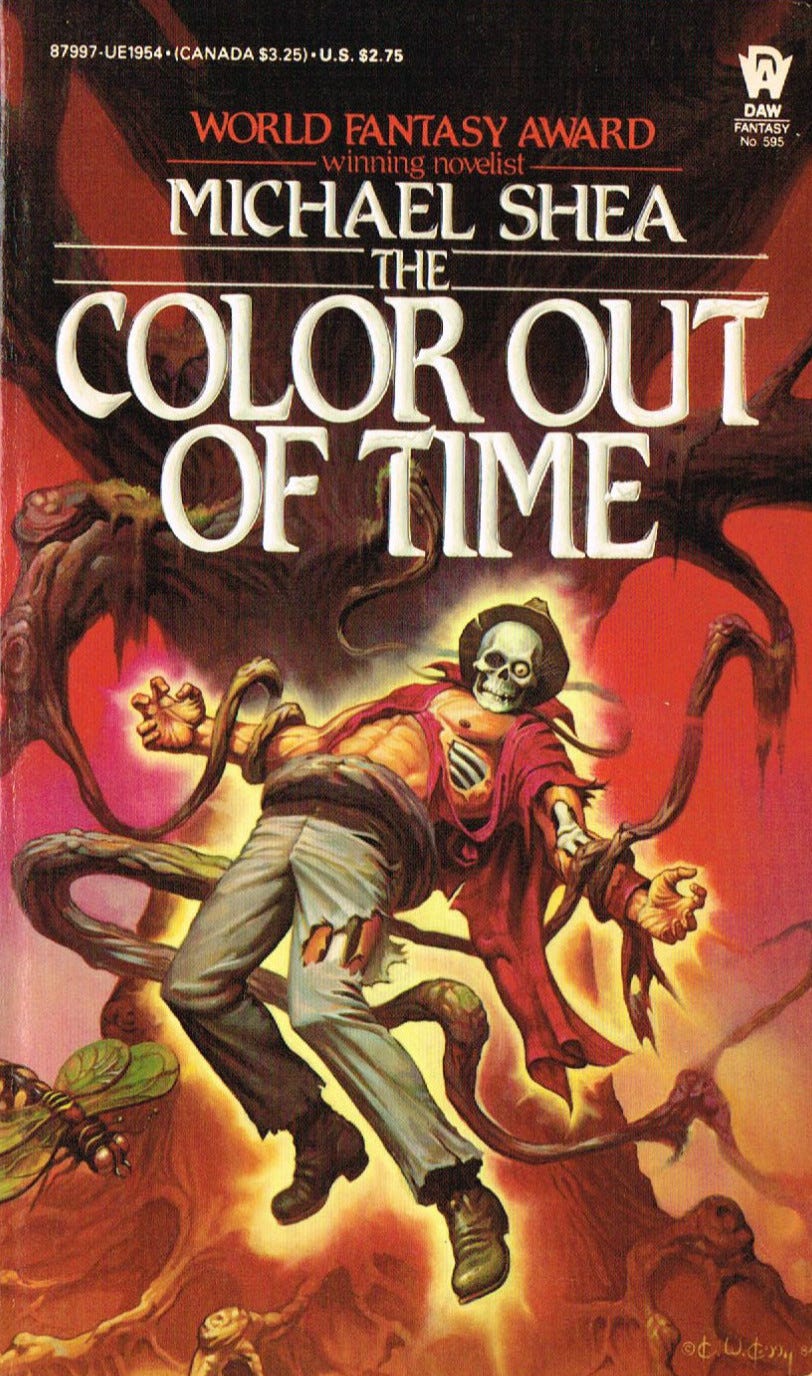
On tonight’s episode of CLASSICS FROM THE GRAVE, we return to two familiar themes: 1) Lovecraft and 2) the horror paperback boom of the 1980s. Michael Shea’s THE COLOR OUT OF TIME (1984) meets both requirements as it is a semi-serious sequel to a Lovecraft classic.
Even those critical of the Old Gentleman from Providence are likely to concede that “The Colour Out of Space” is a masterpiece. Originally published in the September 1927 issue of Amazing Stories, “The Colour Out of Space” is the quintessential sci-fi-horror yarn about a strange blight on an Akrham, Massachusetts farmhouse caused by a crashed meteorite. Filmed in 1965 as Die, Monster, Die!, “The Colour Out of Space” is full of Lovecraft’s linguistic mastery, his unique ability to build dread, and his sharp pessimism, as the titular cosmic intelligence ultimately wins by destroying the Gardner family farm and its inhabitants.
Decades later, in the culturally important year of 1984, horror writer Michael Shea decided to take a stab at “The Colour Out of Space.” What he produced, The Color Out of Time, is a lovely attempt at recreating the mystery of the Lovecraft original. Much like Robert Bloch’s 1978 novel Strange Eons, Shea’s The Color Out of Time envisions a world where Lovecraft based his fiction on reality. The color/colour from the cosmos is real, and just as in the original story, it is always hungry. Shea’s color also stems from a doomed farmhouse, though instead of the Gardner family, it haunted and harassed the poor Simes brood of Massachusetts. Also, The Color Out of Time picks up logically from where “The Colour Out of Space” ends, i.e., the original narrator (a surveyor) successfully completed his job, and the Commonwealth achieved its desired result (the creation of a new lake via damming). Thus, instead of falling from the heavens, the color in Shea’s slim novel bubbles up from the water and assaults summer vacationers.
The Color Out of Time is a mess of a book. It is “Lovecraftian pulp” rather than cosmic horror. Plus, Shea’s attempt to mirror the Master’s purple prose comes across as stiff, and it does little to help the simultaneously simple yet hard-to-follow plot.

Michael Shea (1946-2014) was born and raised in Los Angeles. He attended university at UCLA and the University of California, Berkeley before becoming a wanderer who hitchhiked across the United States and Canada multiple times. According to Shea, it was a chance encounter with Jack Vance’s The Eyes of the Overworld while bumming through Alaska that convinced him to become a fantasy writer. After another round of hitchhiking in France and Spain (plus a short first marriage), Shea sat down and wrote a homage to Vance entitled A Quest for Simbilis (1974). Shea’s debut effort was an attempt to add to Vance’s universe, but Vance made A Quest for Simbilis non-canonical by taking his Dying Earth series in a different direction.
Shea continued to write and hold a variety of odd jobs, including an ESL teacher, construction worker, house painter, and night clerk at a San Francisco flophouse. He married again and, in 1980, published a short story, “The Autopsy,” which was nominated for a Hugo and a Nebula. Shea’s good fortune continued when, in 1983, his dark fantasy novel Nifft the Lean won Year’s Best Novel at the World Fantasy Awards. Shea would pen two more novels in the Nifft series, culminating in 2000’s The A’rak. Shea wrote several other novels, most of which belong to the fantasy genre. He continued to write short stories too, many of which were collected in multiple volumes from 1987 until 2022.
Shea passed away unexpectedly on February 16, 2014. He was sixty-seven.
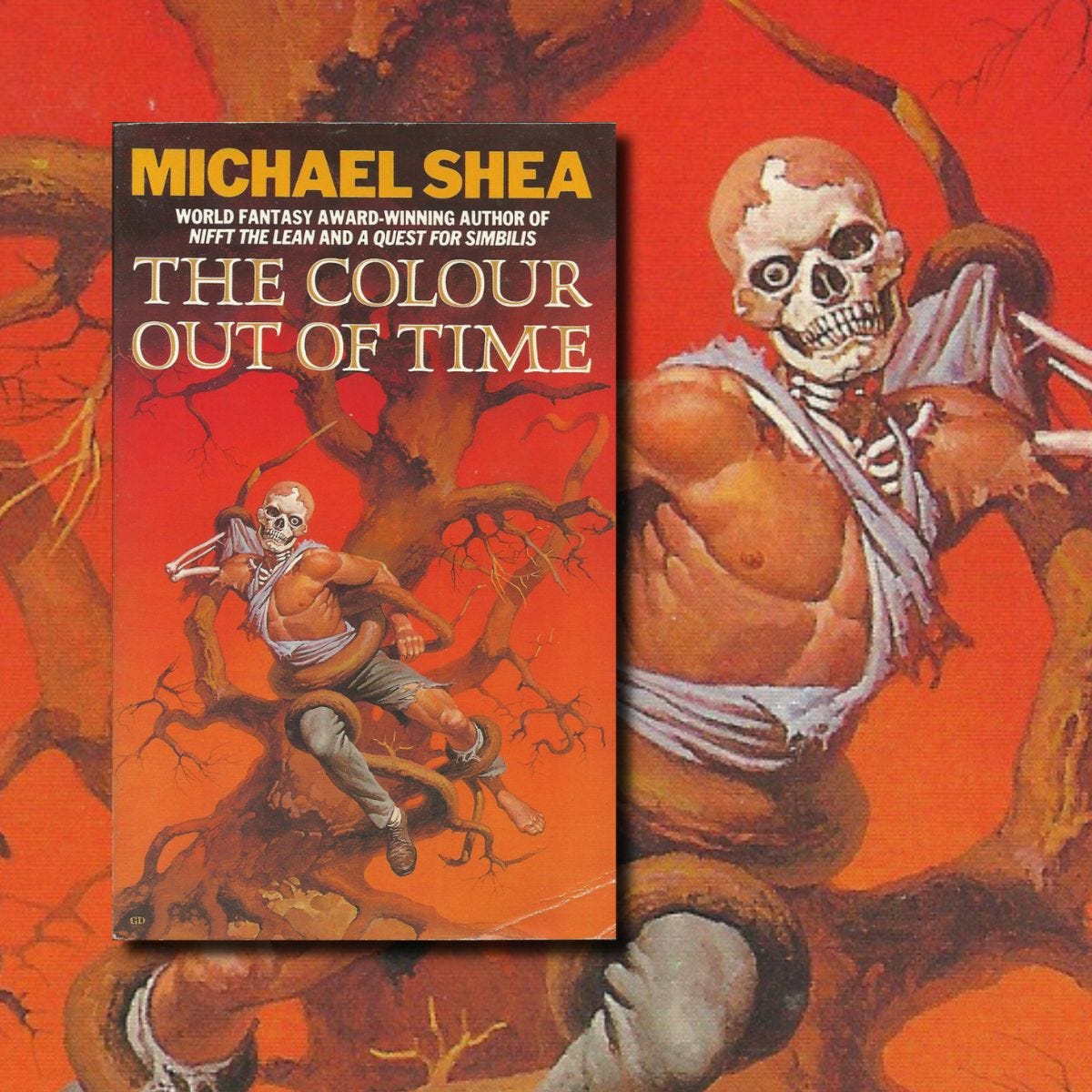
The first of two Lovecraftian novels in Shea’s oeuvre [1], The Color Out of Time sees two vacationing professors—Dr. Ernst Carlsberg and Dr. Sternbruck—get enmeshed in a case of eldritch horror. Sternbruck, our narrator, explains that he and Dr. Carlsberg are old friends, and both are bachelors in their late fifties/early sixties [2]. Their original goal was “gorgeous seclusion” amidst the bucolic charms of rural New England, but instead, the two men find a man-made lake brimming with tourists. Most of these tourists seem to be local kids, but there are also a couple of party boats where a friendly couple from the Midwest say “Bull!” a lot while inviting the elderly Germans to partake in their nightly beer rituals. Then, of course, there are the park rangers responsible for keeping the lake clean and orderly. The man in charge of them is a simple-talking hayseed who admits that he’s never left his small corner of Massachusetts.
Most disturbing of all is the man called Hargis. Mr. Jeffry Hargis is a boisterous, outgoing man who leads a floating men’s club on the lake. Instead of men, he is more often surrounded by boys, specifically teenage boys who enjoy Hargis’s definition of a good time. And what’s that, you might ask? Well, Hargis enjoys drinking (nice), shouting over an electronic megaphone (okay), and watching endless hours of pornographic content with his young friends (Police!!!). Hargis is one of the chief antagonists of the novel, but he does not appear until after page one hundred. Given that The Color Out of Time is a hair under two hundred pages, Hargis’s late appearance means he is not a very effective villain, as he is barely introduced before being dispatched just as quickly. Still, a definite creep.
The larger evil in the novel is the color originally from space. The “vampiric jelly” appears without warning and quickly contaminates the lake with its putrescence. The water turns sour, which in turn makes vacationers and locals alike sick, since the lake is the town’s chief source of drinking water. Carlsberg and Sternbruck are the first to notice the vile color, and their war against the substance begins almost immediately. For a week or maybe two, the two academics swelter in the humidity caused by the color, try to chase it around the lake, and even hike for miles along a trail where all the flora and fauna have grown to gigantic proportions owing to being infected by the color.
The professors get much-needed aid from Miss Sharon Harms, the sister of one of the color’s victims, who proves to be both a crazy cat lady and an old adept. Specifically, the retired typist tells the professors that she knew H.P. Lovecraft personally and, furthermore, that she was the one who told Lovecraft about the fate of the Simes family and the strange color out at their farmstead. Besides being tutored by the learned Lovecraft, Miss Harms also reveals that she became an expert in Lovecraftian magick. She produces several Elder Signs for herself and the two men, and these sigils successfully protected them against color attacks on multiple occasions.
Eventually, after general panic sets in following the public announcement of the lake’s contamination, Carlsberg, Sternbruck, and Miss Harms journey to the bottom of the lake. This proves to be the source of the color, for the blasted Simes farmhouse, including its mummified former occupants, emits the vampiric jelly from its watery tomb. The two men dive deep into the lake, and armed with Elder Signs and electrical coils, they successfully manage to dissipate the color or at least dissipate it for the moment. The novel ends on a dour note, as Sternbruck is left all alone on his boat, waiting for some kind of sign of life from either Carlsberg or Harms.
There is not much substance to The Color Out of Time. As a homage, it is nice enough. Shea writes like someone who actually enjoys Lovecraft and his works, which is refreshing enough given the endless stream of literary and audiovisual “takedowns” of HPL that have flourished since at least 2010. However, as previously mentioned, Shea’s prose herein is a half-hearted attempt to mimic Lovecraft’s, and it mostly fails. The book is entirely readable, yes, but Sternbruck’s narration comes off as phony.
The biggest problem with this small book is its aimless quality. The color appears on the first few pages, and thereafter it is a sea of activity, with the two old professors doing their best to be productive. We see them hike and fret over the oversized insects for a long chapter; their discussions with Miss Harms run over multiple chapters; their interactions with, and the later evisceration of the Midwestern couple, go on for far too long. Then there’s Hargis, who is spoken of in obsidian tones as an ally of the color, but he appears out of nowhere and is only given a few scenes before his boat is ripped to shreds by a Lee-Enfield rifle.
At the risk of sounding mean, The Color Out of Time has the feeling and consistency of a first-timer’s attempt, plus there is the unsightly residue of blatant “fan fic.” The fact that Shea was already a decorated author by the time his book was published makes its amateurish quality even more aggravating. The Color Out of Time is neither bad nor awful, but it’s certainly not good.
1.9 out of 5.
[1] The second, Mr. Cannyharme, was published posthumously in 2021.
[2] Two unmarried and elderly men summering in Massachusetts? Surprising that they didn’t pick Fire Island instead…