
Black Animism
A Review of R.R. Ryan's "Echo of a Curse"
Vampire fiction is, in a word, illustrious. Dracula (1897) was not the first vampire novel, but its shadow looms so large over its descendants that it may as well be both the first and the most perfect vampire novel. Subsequent additions to the canon further immortalized the figure of the vampire as one of the great archetypes of terror. Some of the post-Dracula gems include Richard Matheson’s I am Legend (1954), Theodore Sturgeon’s Some of Your Blood (1961), Stephen King’s ‘Salem’s Lot (1975), Robert McCammon’s They Thirst (1981), and John Steakley’s Vampire$ (1990). The list of great vampire films is far too long to even begin here in this brief essay.
The werewolf, on the other hand, has made only a rather paltry mark in the history of horror literature. For many, the greatest werewolf novel of all time is Guy Endore’s The Werewolf of Paris (1933). Endore, a member of the Communist Party who would later be investigated by the House Un-American Activities Committee (HUAC), decided to set his werewolf yarn during the Paris Commune that followed France’s defeat in the Franco-Prussian War. Maybe this setting is the reason why few read Endore’s novel. Then again, there’s an argument to be made that werewolves don’t make for great fiction in general. The only competitor of The Werewolf of Paris in the fight for “Best Werewolf Novel of All Time” is Gary Brandner’s The Howling (1977), and the latter is not a great novel at all.
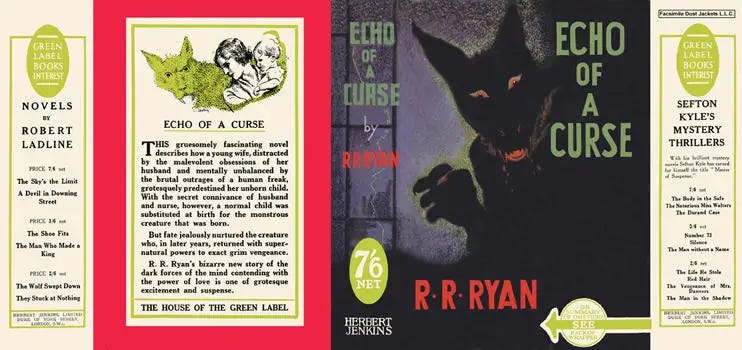
R.R. Ryan’s Echo of a Curse (1939) could be considered a werewolf novel, so long as the definition of what constitutes a lycanthrope is stretched. The word “werewolf” is never uttered in Ryan’s novel, and yet, the central monstrosity is described as having a wolf’s head, an ape’s body, and the unsettling eyes of a cat. Also of note, Echo of a Curse never mentions the full moon, silver, wolfsbane, howling, or the other signs and signifiers of traditional werewolf lore. Instead, Ryan’s novel, which Karl Edward Wagner listed as one of the Thirteen Best Supernatural Horror Novels of all time [1], deals with a familial curse and how this supernatural affliction torments its sufferers and those around them.
R.R. Ryan never existed. The pen name published a slew of popular thrillers in the 1930s. Yet, it was not until the forensic work of a literature scholar, James Doig, that Ryan was unmasked as the British playwright Evelyn Bradley (1882-1950). But wait! Writer and editor John Pelan threw a small wrench into this neat and tidy idea by suggesting that Bradley did not write the Ryan novels alone. Instead, according to Pelan, Bradley wrote in partnership with his daughter, Denice Jeanette Bradley-Ryan, who wrote novels of her own under the pseudonym of “Kay Seaton.” Pelan’s notion makes sense given that the prevailing wisdom for so long was that Ryan had to be a female because of the prevalence of believable female characters. Well, a father-daughter collaboration does not rule out the old notion, and it is noteworthy that all Ryan and Seaton novels disappear after Evelyn’s suicide in 1950 [2].
Most scholars and horror enthusiasts agree that Echo of a Curse is Ryan’s masterpiece. The novel begins with the mud and blood of the Western Front during the Great War. Here, a pair of BEF officers—Terry Cliffe and Vincent Border—become fast friends. For Terry, the friendship is based on Vincent’s captivating handsomeness and his sharp virility. Terry becomes mildly enraptured by the other man. These feelings are not mutual, and one night, during heavy fighting in Flanders, Vincent gets drunk on whisky and goes berserk. This outburst requires Vincent to apologize profusely, and the strange man apologizes A LOT in the first half of this novel because of his booze-fuelled rages.
While on leave, Terry introduces Vincent to Mary. Mary is not only Terry’s lifelong neighbor, but also the love of his life. However, Mary’s first encounter with Vincent convinces her that the lustful and beautiful stranger is worth more of her time than stolid, honorable Terry. The pair engages in courtship right away, with Mary quickly giving in to her more animalistic urges. For a 1939 novel, Echo of a Curse is rather frank in its discussion of sexuality, sexual attraction, and the unspoken desires that can lead to out-of-wedlock copulation.
The war eventually ends, and Terry and Vincent find themselves back in Merrie Olde England. Terry inherits his family’s law firm and manorial home. Vincent inherits Terry’s former flame, and he and Mary soon wed. It is around this time that Terry learns the truth about his friend: Vincent Border is not a twentysomething officer who dropped out of Oxford to serve his country. He is instead a man in his thirties who fled London after being convicted of fraud and statutory rape, with a grievous assault charge added on. Vincent Border is a monster, and Terry duly informs Mary. To his chagrin, Mary does not annul the marriage, and eventually the couple gives birth to twins.
The Border children, Faith and Don, are not what they seem. You see, before their birth, Vincent conspired with a local nurse (whom he was having an affair with) to swap one of the children with another baby. This conspiracy succeeds, and for ten years, Faith and Don are raised together as biological brother and sister.
In the background of all of this chamber drama, an escaped sideshow freak called THE INEXPLICABLE carries out a reign of terror that sees it murder several locals, including Holly, Vincent’s mistress/nurse. THE INEXPLICABLE, which appears to be an ape-wolf hybrid, attacks the Border home one night. The beast is corralled, but, in the midst of the horror, Vincent makes the shocking confession that the monstrosity is his own father. Sick and tired of her husband’s personality (to say nothing of his torments, which include drunkenly molesting and striking her and leaving her outside in the cold without a stitch of clothing), Mary curses her soon-to-be-born children. Is this the curse that will forever taint the House of Border?
Not quite. As the novel enters Book Two and journeys towards its fiery climax, we learn via drips and drabs that Vincent is much more than an adulterer and rapist. He is an occultist who believes in something that he calls “Black Animism.” In the cellar of his home, Vincent conducts eldritch rituals to gain immortality, and in his room, a black altar burns with foul-smelling incense. And Vincent did not lie when he claimed that THE INEXPLICABLE was his father. Like his father, Vincent carries within his blood a satanic curse that manifests itself in lycanthropy. But not just any form of lycanthropy, mind you; this curse also includes elements of vampirism, for all those afflicted are undead and can only be dispatched either via fire or a wooden stake.
Yes, it is a little confusing.
SPOILER ALERT — STOP HERE TO KEEP THE MYSTERY MYSTERIOUS
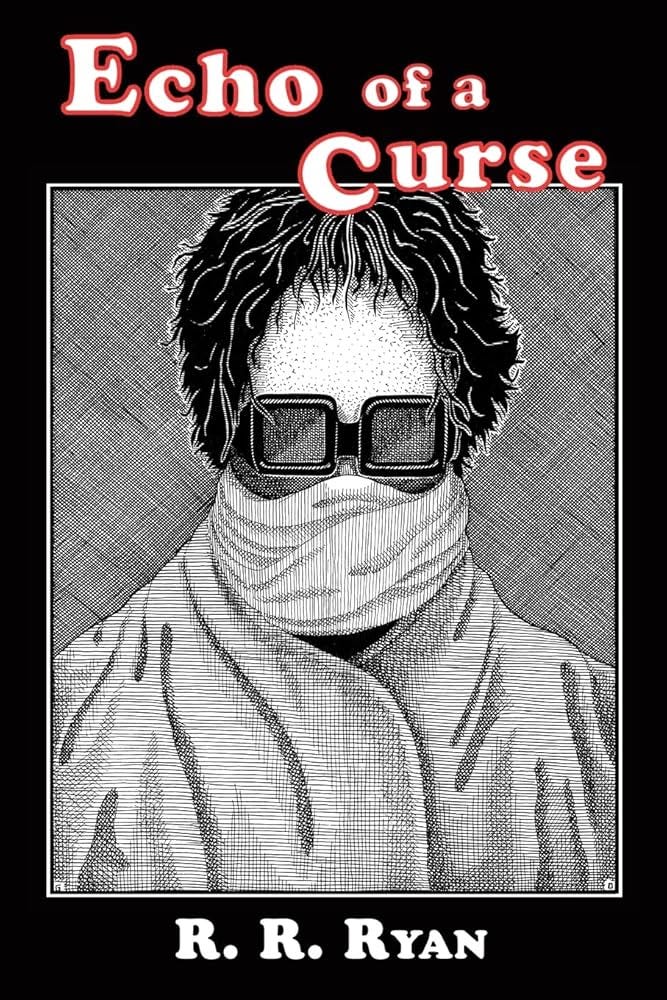
The climax of Echo of a Curse is reached after the arrival of the strange and hooded Mr. Govina. Mr. Govina claims to be a European author who survived a disfiguring fire, but not long after he takes a room at Mary’s house, the old crimes of THE INEXPLICABLE begin to reoccur. Suspicious strangers start sneaking around Mary’s property, and that in turn causes Terry and Don to investigate Mr. Govina. When they see him uncovered, they realize that something more than fire has disfigured his face. The man looks like an evil canine. This ultimately proves true, as Govina is none other than Vincent and Mary’s legitimate son, who was raised as a circus freak on the Continent.
Now, full of rage, Govina wants to kill the mother who cursed him. To do this, he severely wounds Terry, kidnaps Faith, and tries to negotiate with his father for the release of his mother. More specifically, the beast-man Govina wants to trade Faith (whom Vincent dearly loves) for Mary. Vincent convinces Mary to make this trade, and, in the final moments, a blindfolded Mary is led away to a certain death.
But, at the last minute, Vincent, who has spent the entire novel as a blackguard, decides to end the curse for good. He locks himself and Govina in a “strong room” after he has already started a fire downstairs. The pair burn to death in a holocaust of insane laughter. Echo of a Curse then ends with a nice touch: after decades of missteps, Mary and Terry finally become husband and wife.
Echo of a Curse is a solid potboiler that contains dreadful scenes. One that particularly stands out occurs early in the novel when, during a fit of jealousy, Vincent mails his wife a birthday present. The present turns out to be a lovely box containing a dead, mutilated puppy. Such cruel scenes appear here and there in the novel, but more often than not, Ryan leans into suggestion or half-explained occultism to give readers a sense of the true horror at work. One thing that Ryan absolutely does not do is engage in Lovecraftian weirdness. Despite what Ramsey Campbell once wrote, Echo of a Curse lacks any Lovecraftian influence. There isn’t even a whiff of the Old Ones, and what supernatural horror there is is of the Dennis Wheatley variety.
Still, all things considered, Echo of a Curse is an excellent horror novel with only one noticeable flaw (too much drawing room drama; not enough horror). Today’s crop of weird fiction aficionados will find a lot to admire in this novel, and once again, KEW showed some brilliance in helping to rescue Echo of a Curse from the out-of-print purgatory.
4.6 out of 5.
[1] R.R. Ryan is the only author whose work appears in all three categories of Wagner’s 39 List. For more information on Ryan’s scifi-horror novel, Freak Museum, see my review here.
[2] All biographical information on “R.R. Ryan” was taken from “Echoes of R.R. Ryan” by John Pelan & D.H. Olson, Echoes of a Curse (Ramble House, 2014), pp. 7-12.
"Then again, there’s an argument to be made that werewolves don’t make for great fiction in general."
The best piece of werewolf fiction I've read so far is Manly Wade Wellman's "The Hairy Ones Shall Dance." Part of what makes it so interesting is that it reads as if it was written after decades of werewolf stories, cleverly differentiating itself from them and avoiding getting stuck in their typical clichés, but it was, in fact, written a few years before the first Lon Chaney Jr. Wolf Man movie. It is unique both in how it depicts the metaphysical mechanics behind werewolf transformations and in the way that it treats lycanthropy as a sort of supernatural outgrowth of psychopathic serial killer mentality.