
The Blood Madness!
A Review of Hanns Heinz Ewers's "Vampire"
World War I, also known as the Great War, was a massive bloodletting. No part of the world—not Europe, not Asia, not Africa, not the Atlantic and Pacific oceans—was left unscathed. So much blood seeped into the soil that the water turned rust colored; so much gore pervaded the air that, after 1918, mothers produced breast milk that was the color of strawberries. Basically, for five years (1919 was in some ways worse than 1918), the world developed a blood madness that was not fully satisfied until 1945.
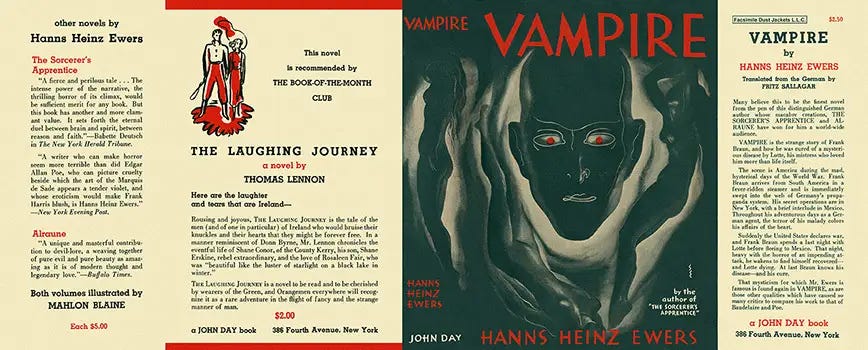
Vampire, the third and final novel in author Hanns Heinz Ewers’s Frank Braun trilogy, addresses this era of global vampirism. Set during the war but far from the battlefield, Vampire follows the Nietzschean hyper-individualist Braun as he becomes an effective propagandist for the German Empire while living and working as a lecturer in the United States. The ever-cynical Braun is good at giving speeches, and, during a long stayover in revolutionary Mexico, he proves his worth as a military advisor. However, despite all his success, Braun suffers tremendously throughout the novel: he experiences bouts of delirium punctuated by violent, vivid dreams, and a deep listlessness depresses his spirits whenever he is alone in his apartment. The cause of Braun’s affliction is unknown, but there seems to be a connection to Lotte van Ness, Braun’s old flame from Berlin, who has developed a keen interest in occultism since moving to America.
Listed by Karl Edward Wagner as one of the Thirteen Best Non-Supernatural Horror Novels of all time, Vampire is the weakest of the Braun novels. The novel meanders for much of its length, taking a long time to establish a clear narrative direction. When it finally reveals its main storyline, the climax and conclusion feel abrupt and underdeveloped, leaving the reader to question whether Ewers had to meet a deadline.
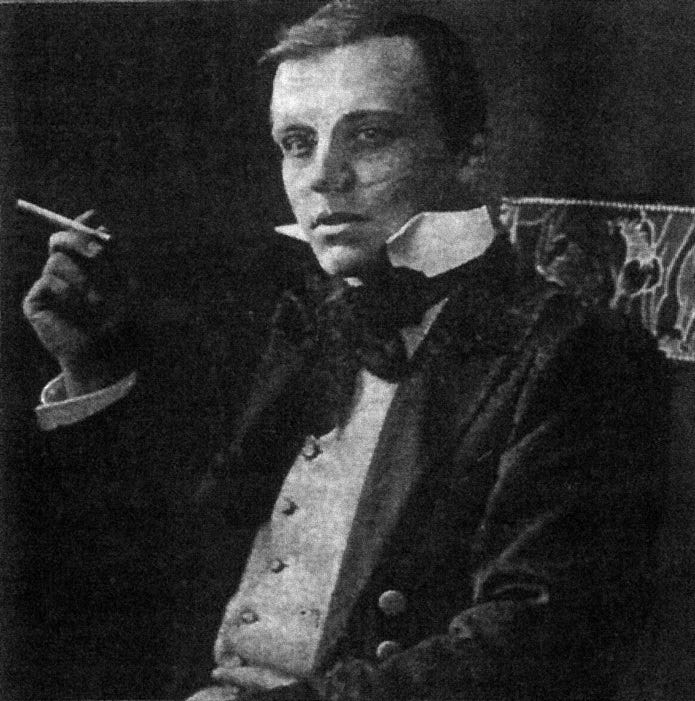
The biography of Hanns Heinz Ewers (1871-1943) has been covered twice before, as Wagner saw fit to include two other Braun novels—The Sorcerer’s Apprentice and Alraune—in his 39 List. Ewers was born a subject of the Kingdom of Prussia and died during the Third Reich. He lived an exciting and flamboyant life, which saw him tour Central Europe as an actor and playwright, serve Kaiser Wilhelm II as a propagandist and spy while headquartered in New York City, and then later take part in the German film industry as an actor, writer, and director [1]. Clearly, Ewers took inspiration from his own life when creating the amoral Frank Braun. Outside of the Braun novels, Ewers was a prolific writer who published short stories, poems, translations, and essays, including book-length discussions of fantasy fiction and esotericism. Ewers’s best-known tale, “The Spider,” is still a staple of horror reprints and anthologies today. Ewers was also a student of the occult and a friend and correspondent of the infamous British magician Aleister Crowley.
His life took an unexpected turn right before the Second World War when Ewers, who was a member of the National Socialist German Workers’ Party (NSDAP, or Nazi for short), was officially sanctioned by Hitler’s government due to his homosexuality, the degenerate quality of his work, and his noted philo-Semitism. Ewers died before the war irrevocably turned against the Axis, and since then, his reputation has fluctuated from being hailed as the “German Poe” to being a forgotten footnote in the history of speculative fiction. Wagner held the former position, and Ewers is one of only two writers to appear three times on Wagner’s list [2].
Vampire was first published in German in 1921 and would not receive its first English translation until thirteen years later. As with the other novels in the trilogy, Vampire makes scant few references to its predecessors. Very early in Vampire, Braun mentions a relative named ten Brinken, plus he makes a passing comment about time spent in Venice. These are the only two references to the events of either Alraune or The Sorcerer’s Apprentice. For the remainder of the novel, Braun acts like a man who has not seen his pregnant lover crucified nor fallen in love with a femme fatale who was produced via the forced insemination of a prostitute. Then again, knowing Braun’s ugly history does help readers to better understand the finale of Vampire, but more on that later.
The final Braun novel begins with Braun wandering through South America as a gaucho, gambler, and all-around bad hombre. Braun admits that he has grown bored with Europe and seeks to continue his directionless dance through life. However, after earning passage aboard a German merchant ship carrying the members of a traveling circus, Braun learns that war has been declared and that all subjects of the kaiser are to report back to Germany to enter either the army or the navy. Braun is in no rush to follow such orders; he is no nationalist, and for him, all matters of identity are foolish. The only thing that matters is the superior individual (which he considers himself to be), and a superior individual enjoys his own morality and his own time. The other issue keeping Braun out of uniform is the appearance of yellow fever aboard the ship. Soon enough, the crew and the circus performers start dying off, and the ship is denied entry at every port. Eventually, San Francisco agrees to let the ship anchor far away from the city. Braun and two other Germans sneak off and find a train that will take them east. It is here, while aboard the American train, that Braun begins having troubling visions. One is a memory, as Braun recalls seeing one of the plague-stricken sailors floating dead in the water. The other, more powerful vision involves an American train passenger whose tobacco spit transmogrifies into scurrying black mice.
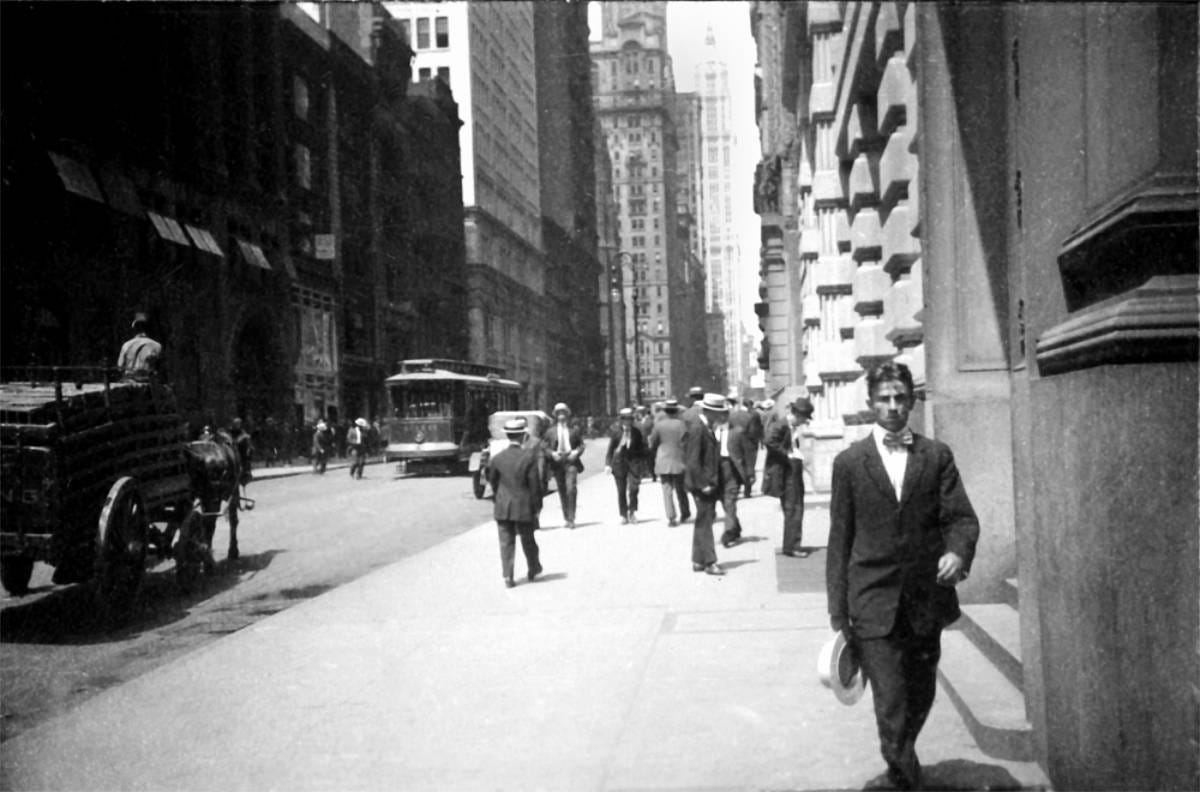
Braun’s journey reaches New York City. His goal is to find a ship that will take him back to Germany, but even though the United States is officially neutral, its police, merchant vessels, and navy are on a mission to arrest or capture any men or material that could help Kaiser Willy. For Braun to return home, he needs a new passport. A man from Baltimore, Tewes, intervenes on his behalf. Tewes is the editor of the Herold and also one of Germany’s chief spy agents in the United States [3]. Tewes ropes Braun into giving a speech during a German American celebration. This speech proves electrifying, and Braun becomes a traveling lecturer who storms across America preaching a pro-German line. In this capacity, Braun participates and often wins debates against American speakers who are vociferously pro-England.
Braun’s lecture circuit, of course, provides the perfect cover for his espionage activities. Spreading propaganda in the United States is one thing, but eventually Braun journeys into Mexico at the height of the revolution. As part of the very real German attempt to weaken American support for the Entente by increasing anti-American sentiment in Mexico in the hopes of starting a war between the two nations, Braun makes contact with Pancho Villa. The German spy watches as Villa, an ardent admirer of the French Revolution, humiliates nuns and priests. He also gets a front-row seat to a party where Villa takes great pleasure in watching a beautiful woman dance the rumba. The said dancer turns out to be one of the survivors from the plague ship, and she and Braun enjoy a brief relationship across the Texas border.
Upon returning to New York, Braun begins experiencing strange spells. Sometimes the usually vigorous German suffers from an all-consuming lethargy. In other instances, Brauns loses track of time and/or sleepwalks. Women are the obvious reason for his distress.
Two women, to be exact.
One is an American named Ivy Jefferson. Ivy is an heiress and belongs to a solidly pro-British family that forbids her from marrying a German. This naturally causes Ivy to take a fancy to Braun, and the couple spend several months attending one society ball after another until they ultimately agree to become husband and wife. Yet, as pat as this plan appears, Ivy abruptly cancels the wedding and kicks Braun to the curb without explanation.
The other woman is Lotte van Ness. Years prior, Lotte van Ness was Lotte Levi [4]. Now independently wealthy thanks to being the widow of an American businessman, Lotte once again takes an interest in Braun. She belongs to the same espionage network as Tewes and Braun, and it’s hinted that she is one of the group’s main financial backers. Lotte is an ardent but idiosyncratic German patriot. Her love for the Fatherland is inspired and increased by her commitment to her father’s people. Although the elder Levi was not an observant Jew and, in fact, converted to Christianity early in life, his daughter has developed a kind of Jewish-German nationalism in which she sees Kaiser Wilhelm II and his nation as the spearhead of a new Kingdom of Israel. Lotte mixes this belief with a newfound obsession with horoscopes and the occult, and furthermore, she tries to convince Braun that her family is fated to lead the German conquest of the world because of the existence of the ancient Israelite tribe of Levi.
It was made the tribe of priests, it was placed above the others and it was to serve as a link between the children of Israel. And it was this tribe, Levi’s tribe, which carried a tricolor flag in the desert. Do you know what the colors of this flag where? Black, white, and red! [5]
It is worth noting that while Braun is in Mexico, he meets a Jewish New Yorker who has gone over to the side of Villa out of anger over American anti-Semitism. In particular, Colonel Pearlstein lambasts his birth nation for refusing to allow him to serve in the armed forces. Pearlstein contrasts this treatment with his family’s experiences back in Austria, where the men all served the Habsburgs as respected army officers. Vampire, therefore, presents Germany and Austria-Hungary as civilizations in which Jews are not only protected and allowed to advance but are also accepted as members of the body politic.
But back to Lotte.
Her relationship with Braun is a strange one. Her infatuation runs deep, and yet she does not get jealous when Braun sleeps with other women (he does this multiple times in the novel). For his part, Braun is so concerned with Lotte’s odd behavior that he springs for a doctor named Cohn—another German patriot of Jewish heritage. A different kind of doctor—a magician and Assyriologist named Dr. Kachele—also gets involved. Kachele provides Lotte with an in-depth horoscope. And for Braun, Dr. Kachele bends his ear, talking about the long history of goddesses, from the Canaanite Astarte to the Indian Kali, whose worship and rites demand blood. This information seems extraneous, given that Dr. Kachele disappears not long after his first appearance.
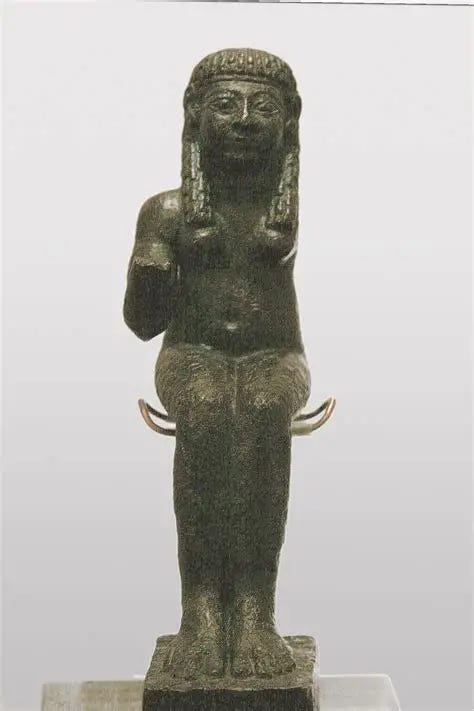
Dr. Kachele’s blood goddess lecture returns with a vengeance in the closing chapters of the novel. Before being arrested and sent to a series of military prisons [6], Braun spends a hideous night alone with Lotte, who allows him to drink blood from her throat. Braun’s prolonged time in prison helps him to realize that he has a natural lust for blood and that this lust was encouraged all along by Lotte. A weakened Lotte confirms this when the two meet again after Braun’s release. She tells Braun she desired to provide him with “milk” (i.e., sex mixed with blood), and in doing so, she sought to meet his primal and unconscious urges. Lotte further informs Braun that his inborn desire for blood has gone mainstream, and she shrieks that a kind of “blood madness” has overtaken the whole world.
Vampire ends on just this note. The titular vampire is neither Braun nor Lotte, but their symbiotic union. Braun’s diseased soul screams for blood, and this is why, in all three novels, his lovers come to bad ends. The difference with Lotte, however, is that she willingly fulfills his deepest desires. This interesting take on aberrant sexuality is only a very small part of Vampire overall, and for the most part, Ewers’s novel is unfocused. The predominant theme of Vampire is Braun-as-observer. A full eighty to ninety percent of the novel is either Braun describing his impressions of American culture or the details of Braun’s many experiences with women, sex, and society. For instance, one costume party is given over ten pages, even though it does nothing to advance the story. Braun is a great character, yes, but his playboy lifestyle alone cannot sustain interest for nearly four hundred pages.
This is the central weakness of Vampire: the core narrative involving Lotte and Braun is buried underneath mountains of supplementary scenes and characters. The horror, which is barely present, is diluted and confined to the final chapter. Although technically more things happen in Vampire than in the other two novels in the trilogy, this, the final installment, feels so unfulfilling because its moments are so often unconnected to anything else.
3.1 out of 5.
EDITOR’S NOTE:
I have now read and reviewed all thirteen of Wagner’s best non-supernatural horror novels. Here are the five best from that list:
Honorable Mentions: Here Comes a Candle, The Shadow on the House
Postscript: There is only one more book from the 39 List left to review, but since it’s nearly 700 pages in length, don’t expect to see my take until February or March.
[1] Ewers wrote the screenplay for The Student of Prague (1913), one of the first full-length horror films. A re-telling of the German Faust legend, Ewers’s screenplay for The Student of Prague also took inspiration from Edgar Allan Poe’s “William Wilson.”
[2] The other writer, R.R. Ryan, appears in all three categories: Echo of a Curse in Thirteen Best Supernatural Horror Novels, Freak Museum in Thirteen Best Science Fiction Horror Novels, and The Subjugated Beast in Thirteen Best Non-Supernatural Horror Novels.
[3] The character of Tewes is clearly modeled after H.L. Mencken (1880-1956). Born and raised in Baltimore, Mencken was the son of a German family that spoke their native tongue at home. Mencken was the leading light at the Baltimore Sun, and throughout World War I, he was unapologetically pro-German. For fans of pulp fiction, Mencken is best known for co-founding the magazine that would become Black Mask.
[4] Character appears in the final chapters of The Sorcerer’s Apprentice.
[5] The colors of the German imperial flag.
[6] All of this happened to Ewers. He was detained as an enemy alien and suspected spy by the U.S. government, and he spent the majority of World War I and the immediate aftermath as a prisoner in Georgia.
Good review. It took me close to thirty years to read all the books on KEW's list. I've included some on my own substack. I look forward to reading more reviews from the KEW lists.
Great review!